Showing posts with label Domestic Life of The ARYANS. Show all posts

Friday, July 11, 2014

World Heritage Sites - Ajanta Caves

The Ajanta Caves (1983) Maharashtra

The  Ajanta Caves (75°40’ N; 20°30’ E) are situated at a distance of 107 km north of Aurangabad, the district headquarters. The caves attained the name from a nearby village
named Ajanta located about 12 km. These caves were discovered by an Army Officer in the Madras Regiment of the British Army in 1819 during one of his hunting expeditions. Instantly the discovery became very famous and Ajanta attained a very important tourist destination in the world. The caves, famous for its murals, are the finest surviving examples of Indian art, particularly painting.

These caves are excavated in horse–shoe shaped bend of rock surface nearly 76 m in height overlooking a narrow stream known as Waghora. The location of this valley provided a calm and serene environment for the Buddhist monks who retreated at these secluded places during the rainy seasons. This retreat also provided them with enough time for furthering their religious pursuits through intellectual discourses for a considerably longer period. The caves were excavated in different periods (circa. 2nd century B.C. to 6th century A.D.) according to the necessity. Each cave was connected to the stream by a flight of steps, which are now almost obliterated, albeit traces of some could be noticed at some places.

In all, total 30 excavations were hewn out of rock which also include an unfinished one. Out of these, five (cave no. 9, 10, 19, 26, and 29) are chaityagrihas and the rest are viharas. In date and style also, these caves can be divided into two broad groups. The earliest excavations belong to the Hinayana phase of Buddhism of which similar examples could also be seen at Bhaja, Kondane, Pitalkhora, Nasik, etc. In total, 5 caves at Ajanta belong to this phase, viz., 9 & 10 which are chaityagrihas and 8, 12, 13, & 15A which are viharas. These caves are datable to the pre-Christian era, the earliest among them being Cave 10 dating from the second century B.C. The object of worship is a stupa here and these caves exhibit the imitation of wooden construction to the extent that the rafters and beams are also sculpted even though they are non-functional.


The addition of new excavations could be noticed again during the period of Vakatakas, the contemporaries of the Imperial Guptas. The caves were caused to be excavated by royal patronage and the feudatories under the Vakatakas as illustrated by the inscriptions found in the caves. Varahadeva, the minister of Vakataka king Harishena (A.D. 475-500) dedicated Cave 16 to the Buddhist Sangha while Cave 17 was the gift of a prince (who subjugated Asmaka) feudatory to the same king. The flurry of activities at Ajanta was between mid 5th century A.D. to mid 6th century A.D. However, Hieun Tsang, the famous Chinese traveller who visited India during the first half of 7th century A.D. has left a vivid and graphic description of the flourishing Buddhist establishment here even though he did not visit the caves. A solitary Rashtrakuta inscription in cave no. 26 indicates its use during 8th – 9th centuries A.D. The second phase departs from the earlier one with the introduction of new pattern in layout as well as the centrality of Buddha image, both in sculpture as well as in paintings

The world famous paintings at Ajanta also fall into two broad phases. The earliest is noticed in the form of fragmentary specimens in cave nos. 9 & 10, which are datable to second century B.C. The headgear and other ornaments of the images in these paintings resemble the bas-relief sculpture of Sanchi and Bharhut.

The second phase of paintings started around 5th – 6th centuries A.D. and continued for the next two centuries. The specimen of these exemplary paintings of Vakataka period could be noticed in cave nos. 1, 2, 16 and 17. The variation in style and execution in these paintings also are noticed, mainly due to different authors of them. A decline in the execution is also noticed in some paintings as indicated by some rigid, mechanical and lifeless figures of Buddha in some later period paintings. The main theme of the paintings is the depiction of various Jataka stories, different incidents associated with the life of Buddha, and the contemporary events and social life also. The ceiling decoration invariably consists of decorative patterns, geometrical as well as floral.

The paintings were executed after elaborate preparation of the rock surface initially. The rock surface was left with chisel marks and grooves so that the layer applied over it can be held in an effective manner. The ground layer consists of a rough layer of ferruginous earth mixed with rock-grit or sand, vegetable fibres, paddy husk, grass and other fibrous material of organic origin on the rough surface of walls and ceilings. A second coat of mud and ferruginous earth mixed with fine rock-powder or sand and fine fibrous vegetable material was applied over the ground surface. Then the surface was finally finished with a thin coat of lime wash. Over this surface, outlines are drawn boldly, then the spaces are filled with requisite colours in different shades and tones to achieve the effect of rounded and plastic volumes. The colours and shades utilised also vary from red and yellow ochre, terra verte, to lime, kaolin, gypsum, lamp black and lapis lazuli. The chief binding material used here was glue. The paintings at Ajanta are not frescoes as they are painted with the aid of a binding agent, whereas in fresco the paintings are executed while the lime wash is still wet which, thereby acts as an intrinsic binding agent.

Open from 9 A.M. to 5 P.M.

Closed on Monday

Entrance Fee:

Citizens of India and visitors of SAARC (Bangladesh, Nepal, Bhutan, Sri Lanka, Pakistan, Maldives and Afghanistan) and BIMSTEC Countries (Bangladesh, Nepal, Bhutan, Sri Lanka, Thailand and Myanmar) - Rs. 10 per head.

Others: US $ 5 or Indian Rs. 250/- per head


(children up to 15 years free)

Monday, May 26, 2014

The Excitement of Hands-on Archaeology

Nothing beats the excitement of hands-on archaeology, and with the new digging season almost upon us, there is no time to lose.

This is a chance to get practical experience, either before heading off to university, or putting into practice what has been studied in theory. But for most, this is simply a glorious way to pass the time.

Our guide covers the full gamut of locations, periods, and types: from fieldwalking to recording and cataloguing, from early Neolithic to Medieval and later – there is something for everyone. Some jobs require stamina, but many do not. Young or old, fit or not, time rich or time poor, all you need is enthusiasm and a desire to get involved.

Use the options below to sort the digs by area, by cost, or by time period – whatever your budget or area of interest, there will be something to suit you. If you don’t have much time to spare try the ‘Dig for a Day’ list, or ‘All Inclusive’ if you want food and accommodation within the cost. There is also an Advice and Useful Info page that will help you know what to expect, along with advice from both diggers and supervisors, as well as a handy checklist so nothing gets forgotten!

So, if you are passionate about Prehistory, interested in the Iron Age, ruminating about Romans, or looking for a new angle on the Saxons, get out into the fresh air and discover…who knows what?

In your complete guide to archaeological excavations around the country, there is no excuse not to join in: look through our list of digs, find one that suits you – then enjoy getting dirty digging up the past!

Friday, May 16, 2014

The discovery of Machu Picchu

The spectacular ‘lost city of the Incas’ high among the Andes mountains in Peru attracts so many visitors today and their presence causes so much damage that a limit has had to be put on their numbers. Hiram Bingham, the man who first revealed it to the world, was a buccaneering American explorer, born in Hawaii in 1875. His parents were missionaries and hoped he would follow in their footsteps, but his youthful efforts to do so made him feel physically sick and he preferred playing American football. Educated privately in New England, he went to Yale University in 1894 to embark on an academic career. He was strongly interested in Latin American history and studied for his PhD in it at Harvard. Fortunately for him and the
world at large in 1900 he married – to her parents’ dismay – a girl called Alfreda Mitchell. She was an heiress to the Tiffany jewellery fortune and Bingham used her money to travel in South America. He was appointed a lecturer at Yale but found exploring far more interesting than teaching. His enthusiasm for exploring extended to women as well and he took full advantage of his travels away from home.

In 1906 Bingham traced Simon Bolivar’s routes through Venezuela and Columbia in the 1820s. In 1909 he explored historic South American trade routes and took the old one from Buenos Aires to Lima in Peru, going on to Cuzco. In 1911 he led a small expedition to Peru in search of the ‘lost city’ of  Vilcabamba, the last refuge of the Inca Manco Capac II, who fought against the Spanish conquerors in the 1530s. This took Bingham and his party of seven to Cuzco and from there by mule and on foot to a small settlement called Mandor Pampa, near Aguas Calientes, where they encountered a local farmer named Melchor Arteaga. Through Bingham’s policeman-interpreter, Arteaga told him that there were extensive ruins high in the mountains nearby at what Arteaga in his native Quechua called Machu Picchu, meaning "old mountain".

They climbed up to the ruins next morning through a persistent drizzle of rain. No one else in Bingham’s party showed any interest, but Bingham, Arteaga and the interpreter spent two exhausting hours clambering up the mountain to a small hut occupied by peasants who were growing crops there. They greeted the American hospitably and deputed a small boy to show him the astonishing things close by. They soon came to what Bingham called ‘an unexpected sight, a great flight of beautifully constructed stone terraces, perhaps a hundred of them, each hundreds of feet long and 10 feet high.’ They continued along one of the terraces: ‘Suddenly I found myself confronted with the walls of ruined houses built of the finest quality of Inca stonework.’ The ruins were overgrown by trees, bamboo thickets and tangles of vines and covered with moss, but the white granite walls were ‘carefully cut and exquisitely fitted together’ and the scene ‘fairly took my breath away.’

Bingham was sure he had discovered Vilcabamba. He believed that to the end of his life, mistakenly as it turned out, and he was fascinated by the mystery and magic of the place, with the great snowy peaks looming above it. Returning in succeeding years he took thousands of photographs. He also took thousands of objects to the United States for study and safekeeping, which was to cause wrangling between the Peruvian government and Yale University for years afterwards.

After the First World War Bingham went into politics in Connecticut and was US senator for the state at the turn of the 1920s and 1930s. He and Alfreda had seven children but by 1937 she could stand his persistent infidelity no longer and divorced him. In the 1950s he had a controversial role as head of President Truman’s new Loyalty Review Board, which made it easier to dismiss civil servants for Communist sympathies. He died in Washington DC at the age of 80 in 1956.

The Spanish conquistadors never saw Machu Picchu and consequently never wrote about it. A few other outsiders had seen it in the years before Bingham, but he was the one who revealed it to the world at large and it made him famous. He has a moon crater named after him and the character of Indiana Jones is thought to owe something to him but he is not highly regarded by scholars. He was not trained in archaeology, his theories were wrong and the real Vilcabamba was discovered by another American explorer, Gene Savoy, in 1964. Machu Picchu is now believed to have been the mountain retreat of the great Inca emperor Pachacutec (‘He who Shakes the Earth’), abandoned at some point after his death in 1472.

Thursday, May 15, 2014

NORTHERN LIGHTS AURORA BOREALIS - THE FACTS

 What are the Auroras or Northern Lights?

The Northern Lights or Aurora Borealis are discharged particles from the sun that pass through the magnetic shield of earth and create light when they mix with atoms and molecules such as nitrogen and oxygen gases on entering into the earth's atmosphere. These particles travel 149 million kms or 93 million miles through space towards planet earth being drawn towards the earth's magnetic north and south polar regions.

Inside the Sun

The brighter areas are sun spots- portals where gases escap
photo : NASA

If the sun was hollow earth would fit 333.000 times inside it's mass, at it's core temperature the sun is around 27 million degrees and is made up of mainly hydrogen gas. It behaves similar to a pot of boiling water, as water boils to the surface of a pot in a mushroom form it cools by letting off heat and then returns downward to be reheated again. As the sun's burning gases go through this similar process some particles escape from portals on the surface called Sun Spots and enter into space as flying plasma particles named Solar Wind.


Sun Spots
The sun has many magnetic fields that emerge from within the sun forming loops that protrude out from the
Explosions shaped by the suns magnetic fields blast through
sun spot portals. photo: NASA
surface, like spaghetti in boiling water. As the sun rotates these magnetic fields get distorted, twisted and knot together where they burst and a sun spot is born. They usually appear in pairs and can vary in size the largest being several times the diameter of earth. These sun spot portals are responsible for the solar wind projections.


The earth's protective shield

The Solar Wind travels at an extraordinary speed covering the 93 million miles to earth in a staggering 2 to 3
days. It's around 1000km per second or a million miles per hour. Normally the earth can deflect such space matter easily because of earth's magnetic field which acts as a protective shield (kind of like water flowing around a stone in a river). However in high activity cycles called Solar Flares the increased particles travel through space and bombard our magnetic shield to deform it slightly in shape. Some of these particles penetrate our magnetic field and come into contact with different gases which produce the aurora northern lights that we see.

The colors of the Aurora
As the solar wind particles enter the earth's atmosphere they collide with molecules of nitrogen and
oxygen which relinquish their agitated energy in the form of light. Oxygen typically produces green and yellow light while nitrogen produces reds, violets and occasionally blue. Violets typically form a boarder around curtains of green aurora shapes in lower altitudes.


The Aurora shapes
The Northern Lights can be both static and dynamic throughout the night sky. During periods of minimum solar flares the aurora can produce a blanket strip type of light without much definition or varying color. However during periods of strong solar flares the light becomes dynamic which swirls, dances and even races in curtains and columns in a random path throughout the sky. The colors merge and diverge from greens to reds and violets. The sight is spectacular beyond belief.

When and where to see the Northern Lights
Where - The auroras can be seen at the polar regions of the north and south pole. However the south pole is
largely inaccessible to human life and the north polar region is easily accessed from Europe. The best chance you have is to visit the latitudes in the Arctic Circle from 68 to 74 degrees. Alaska and parts of Canada are also good for sightings but due to the great vast open expanses of these countries it can make a visit to them an real logistical expedition. Norway and the northern parts of Scandinavia are easily accessible and provide one of the best places in the world to witness auroras or northern lights in Norway.

When - during the winter season as this is due to the low light pollution and crystal clear air. The auroras occur all year round but we need nightfall to see it as the sun's light during the day overpowers the northern lights. The Aurora activity seems to be at it's most active late evening between 10pm and 1am but can be seen in the afternoons during the polar winter above the Arctic circle.

The sun's cycle - sun spots increase and decrease on an 11 year cycle. Since records began in 1749 there have been 22 full cycles. 2009 / 2010 is in the  23 cycle and the next solar maximum will be 2013. During periods of solar maximum the aurora can be seen far below the Arctic Circle and as far as central Europe and intense northern lights activity can interfere with radio, satellite and GPS signals sometimes shutting down networks.  The sun rotates around it's own axis once every 27 days so after a period of high northern light activity has taken place in Northern Norway it is common that after 27 days there will be another strong display of the aurora as the sun spots once again face earth.
The world's climate and the sun
The world's climate is also believed to be influenced by these solar cycles as past planet history has shown that warm and cold cycles may be linked to periods of solar maximum and minimum cycles but the total impact is still not fully understood - but I will update as I find!

Your chances of seeing the Aurora - northern lights
During autumn and winter there is a strong chance to see the aurora during the evenings. Periods of high pressure weather systems are best as they present clear cold skies, a low moon and no urban lighting is an advantage. A close look on the satellite observations of the sun are important and it is possible to forecast the aurora activity within three days accuracy as NOAA polar satellites monitor the aurora activity and solar storms on the sun.
Graham Austick.

Sunday, May 11, 2014

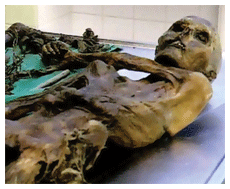
OTZI THE ICE MUMMY

Otzi the Iceman is well naturally preserved mummy of a man. The man who was been captured in Ice was believed to be over 53 centuries old (3300 BC).

How the mummy was found:

The mummy was found by Helmut and Erika Simon a German couple who were hiking the Oetzal Alps on 19th Sep'91. At first the couple thought that it was some mountain climber's mummified remains, but they finally decided to take a photo and report the incident to a nearby lodge caretaker, Markus Pirpamer. He in turn informed the respective authorities.

Discovery of true age:

The body was harshly removed from the ice by some ignorant local authorities, which caused some damages to the mummy. It was taken to a morgue in Innsbruck.Since then it has been in display in South Tyrol Museum of Archaeology in Bolzano, Italy.

Tattoos, Clothes, Equipments:
Otzi was considered to have 57 carbon tattoos in his lower spine,behind his knee and right ankle. All the tattoos were of simple dots and lines. The tattoos were located near acupuncture points.Some scientists believe that these are ancient type of acupuncture and were used to treat otzi for some of the diseases he was suffering from. His clothes were highly sophisticated. He was wearing
A Poncho
A bear fur cap tied with two leather straps
Cloak made of woven grass
Loincloth
Pair of leggings
Belt

Equipments found:
Copper axe with yew handle
Flint knife with ash handle

Cause of death:
At first it was believed that Otzi would have died due to a heavy winter storm. But X-rays, CT scan revealed that an arrowhead has wedged in one of his shoulder when he died. It was alleged that Otzi must have been a victim of a ritual sacrifice.

The theory was inspired by other discoveries such as Tollund Man and Lindow Man.He would have suffered unusual blood loss with no treatment available. He also had several cuts in hands, wrist and chest.

Otzi's Curse:
Influenced by the "Curse of Pharaohs" it was believed that Otzi mummy was cursed. The claim is that the deaths of some main people connected to the discovery and examination of Otzi have died under mystifying conditions. This includes the
Rainer Henn - was on the way to present new findings of the remains. "Head collision car accident."
Kurt Fritz - guided Dr.Henn to the location of Oetzi,Died in a avalanche shortly after that.
Rainer Hölz - created an hour long documentary of Otzi. Died of a brain tumor few months later.
Helmut Simon - discoverer, went for a walk disappeared and was found dead 8 days later.
Tom Loy - ground breaking DNA analysis on the corpse, died of blood clot.

Recent Findings:
Dr. Loy found four DNA samples from Otzi's blood. The theory talks a little prequel to his death, a sequence of events that could have happened before Otzi's struggling death. DNA samples done on Otzi man revealed blood traces of four other people,
One from his knife

Two from the same arrowhead

And a fourth from his coat
The events are understood as Otziwas able to kill two of his rivals with the same arrowhead pulling it successfully out each time. The blood on his coat, should have been his wounded pal whom he had been carrying in this fuss.

Latest studies reveal the cause of his death was not just by blood loss due to the arrow head, but he had received a hard blow from the back of his head. The blow could have been due to a fall or someone hit him hard from behind.

Friday, May 9, 2014

Oldest Bog Body with Skin undamaged

Archaeologists have discovered the remnants of a 4,000-year-old man conserved in an Irish peat bog, staining the oldest European body ever established with skin still unbroken.
The chilly, sodden circumstances of Northern European bogs create low-oxygen, extremely sour environments ideal for body continuation. As an effect, hundreds of "bog bodies" dating reverse thousands of years have been revealed in the state, but many have withered down to habitually skeletons and lean to be quicker to 2,000 years old.


An occupant of middle Ireland's County Laois came diagonally the fresh-looking (Cashel Man)  named for the bog he was found in while milling for peat moss, which is used for a range of ranch purposes, together with animal-bedding and meadow taming.
(All that was visible to start with was a pair of legs below the knees, and a torso), Eamonn Kelly, an archaeologist at the National Museum and lead excavator of the project, wrote in the report. (The body appeared to be naked. Later, it was possible to work out that the torso had been damaged by the milling machine, which also removed the head, neck and left arm.)
The team intended the age of the body using radiometric carbon dating, in which the steady decompose rate of radioactive carbon-14 is used to approximate age based on outstanding levels of carbon-14 in the quiet tissues. Amazed to locate the body was generally 4,000 years old, the team dated the peat over and under the body to prove the results, and came up with about the same age.
The researchers also originated cuts down the man's back that looked like ax wounds. They naked axes capable of producing such wounds within the vicinity of the site.
Given this indication of cruelty, the team completed that the young man had been killed in a sacrament forfeit, a observe generally well-known in later eras, but not well acknowledged in the Early Bronze Age of 2000 B.C., about the time this bog body would've lived.
(All the indications are that the human ruins from Cashel Bog tell of the fate of a young king who, through folly or misadventure, was deemed to have failed to appease the goddess on whose benevolence his people depended, and who paid the ultimate price), Kelly wrote.

Archaeological proof proposes King Solomon's excavation subsists

Archaeologists performing excavations in the south of Israel say they've exposed copper mines old-fashioned to the days of King Solomon.
Copper mines formerly thinking to have been built by early Egyptians in the 13th century B.C. really instigated three centuries later through the control of the legendary King Solomon, they said.
Intellectual study and investigation of materials found in the area -- the Timna Valley in Israel's Aravah Desert -- advocate the mines were operated by the Edomites, a semi-nomadic ethnic amalgamation mentioned in the Bible as warring regularly with Israel, a liberate from the American Friends of Tel Aviv University reported Tuesday.
"The mines are definitely from the period of King Solomon," Tel Aviv archaeology Professor Erez Ben-Yosef said. "They may help us understand the local society, which would have been invisible to us otherwise."
Excavation revealed a massive smelting camp containing the remnants of hundreds of furnaces and layers of copper slag, the waste created during the smelting process.
Cooperation among thousands of people would have been required to operate the mines in the middle of the desert, the researchers said.
(In Timna Valley, we unearthed a society with undoubtedly significant development, organization, and power," Ben-Yosef said. "And yet because the people were living in tents, they would have been transparent to us as archaeologists if they had been engaged in an industry other than mining and smelting, which is very visible archaeologically.)

Archaeologists Discover Last Neanderthals

Archaeologists have finished an important discover on a promontory to assist illustrate the home of the last Neanderthals in northwest Europe.
An archaeological excavate at Le Cotte de St Brelade in Brelade, Jersey, unearthed items which divulge the existence of Stone Age hunters at the bluff, The Register reported.
"In terms of the volume of residue, archaeological prosperity and deepness of time, there is nil else like it known in the British Isles," said Dr Matt Pope of the Institute of Archaeology at University College London, a research leader.
"Given that we consideration these deposits had been detached completely by earlier researchers, ruling that so much still leftovers is as thrilling as discovering a new site."
The site, which is off the coast of Normandy, France, has exposed more Neanderthal stone tools than the rest of the British Isles simultaneously. It holds the only known late caveman remains in Northwest Europe and an imminent into the early relatives of early human beings.
The archaeologists dated sediments at the cave site using a technique called optically enthused luminescence, which events the last time sand grains were uncovered to sunlight.
Dr Pope said the results showed that part of the succession of sediments dates between 100,000 and 47,000 years old, representing that Neanderthal teeth which were exposed at the site in 1910 were younger than earlier thought, and "doubtless belonged to one of the last Neanderthals to live in the region".

For more interesting topics related to archaeology, visit archaeology excavation.

Monday, May 5, 2014

Domestic Life of The ARYANS


Copyright © 2014 Archaeology Excavation