Showing posts with label Archaeological proof proposes King Solomon's excavation subsists. Show all posts

Sunday, June 29, 2014

World Heritage Sites - Churches of Old Goa

  Churches and Convents of Goa (1986), Goa

The Churches and Convents at Velha (Old) Goa owe their existence to the Portuguese rule in this part of the western coast of India.

The most comprehensive group of churches and cathedrals built during 16th to 17th century AD at Old Goa comprise of the following:

Se' Cathedral, Church and Convent of St. Francis of Assisi, Chapel of St. Catherine, Basilica of Bom Jesus; Church of Lady of Rosary; Church of St. Augustine.

The Church of St. Cajetan is modelled on the original design of St. Peter's Church in Rome. The Church of Bom Jesus with its facade decorated with Ionic, Doric and Corinthian pilasters, shows the application of the Classical order. The Se' Cathedral which was begun as a small chapel built of mud and straw under the order of Alfonso Albuquerque after his conquest of Goa is yet another example of Renaissance with its Tuscan exterior, the Corinthian columns at its portals, the raised platform with steps leading to the entrance and the barrel-vault above the nave. The principal chapel is large and ornamented with engraved pillars and pilasters. The images of Senhora d’Esperanca (Our Lady of Hope), Christ crucified and St. Catherine standing in the centre with statues of St. Peter and St. Paul on either side.

The paintings in the churches were done on wooden borders and fixed between panels having floral designs as in the chapels housing the tomb of St. Xavier, the arches above the altars in the transept of the Se' Cathedral and in the nave on either side of the main altar in the Church of St. Francis of Assisi. Excepting a few which are in stone, the statues are mostly in wood delicately carved and painted to adorn the altars. They depict mostly the saints, Mother Mary and Jesus on the cross.

Bom Jesus is said to be one of the grandest Churches to be raised in Asia vast and magnificent with ornaments suited to its greatness. Made of black granite, it part Doric and part Corinthian façade is elaborately carved. The ceiling is highly decorated. Sarcophagi of illustrious Portuguese who were connected with the religious life of Goa are very interesting. Its high and broad altar is dedicate to the figure of infant (Bom) Jesus.

The monuments are open on all the days, i.e. throughout the year (inclusive of all public, state, national holidays)


Open from: 8.30 A.M to 5.30 P.M – Church complex


Sunrise to sunset - other monuments

Thursday, June 26, 2014

Genetic study of cave millipedes reveals isolated populations and ancient divergence between species

The International Journal of Myriapodology recently published the first population genetic study of cave millipedes. This research highlights an important challenge in the conservation of cave biodiversity -- that for many species caves are 'islands' of habitat that support isolated and genetically distinct populations.

The southern Cumberland Plateau in Tennessee and Alabama, USA is known for its high cave density. In addition, it has the highest cave biodiversity of any region in North America. Millipedes of the genus Tetracion range across this biodiversity hotspot. These millipedes, which can grow up to 8 cm in length, are common scavengers in cave communities. Like many cave animals, Tetracion millipedes have reduced pigmentation and non-functional eyes.
The authors used genetic techniques to compare Tetracion populations and species. They found that Tetracion populations were generally isolated from one another. In addition, divergence between Tetracion species was high, suggesting that members of the genus diverged several million years ago.

Monday, May 26, 2014

Richard III to be reburied in Leicester

The remains of Richard III are to be re-interred in Leicester Cathedral – likely next spring – a judicial review concluded today (23 May).


Addressing crowds of journalists in the cathedral, shortly after the High Court handed down their decision at 10am, the Rt Rvd Tim Stevens, Bishop of Leicester, announced that the judges had ruled that the Ministry of Justice license granted at the outset of the University of Leicester’s excavations on the Grey Friars site (see CA 272 for more on this project),  - which stated that, if found, Richard’s bones would be reburied in Leicester Cathedral – should be upheld.

The license had been contested as, after the identity of the skeleton had been confirmed (see CA 277), the Plantagenet Alliance, a group of 15 distant relatives of the king, argued that there should have been wider consultation before Richard’s final resting place was determined. But now, following nine weeks of deliberation, their legal challenge has been dismissed.

‘We are of course delighted that the ruling has gone in our favour – we can now begin planning for the re-interment to proceed with dignity and honour, ‘ said Bishop Stevens.

He went on to read out a postscript that the judges had appended to their ruling:


‘Since Richard III’s exhumation on 5 September 2012, passions have been roused and much ink has been spilt. Issues relating to his life and death and place of re-interment have been exhaustively examined and debated. The Very Reverend David Monteith, the Dean of Leicester Cathedral, has explained the considerable efforts and expenditure invested by the Cathedral in order to create a lasting burial place “as befits an annointed king”. We agree that it is time for Richard III to be given a dignified reburial, and finally laid to rest. ‘

Dean David Monteith added that he hoped the ceremonies surrounding Richard’s re-interment would help to foster a spirit of cooperation and reconciliation between differing parties.

‘Wherever you sat on this matter, everyone is welcome to participate in what comes next,’ he said. ‘We are going to lay a man and an annointed king to rest, and we should do this as one community and one nation working together to ensure it is done with dignity and honour. ‘

Plans for the reburial itself are still in progress, though it is expected that the ceremony will involve events over four or five days, during which Richard’s remains will be taken back to Bosworth battlefield, before being processed back into Leicester via a number of sites associated with the battle, and churchyards where other people killed on that day are buried.

Richard III will then lie in state in the cathedral for a number of days to allow members of the public to pay their respects, after which he will be buried in a tomb (the revised design of which is to be unveiled in 3-4 weeks) just a few feet from the ledger stone currently dedicated to him in the cathedral’s choir.

‘The cathedral is a working building so the location of the tomb had to allow for the circulation of people, and the performance of services, ‘ said Richard Buckley of University of Leicester Archaeological Services (ULAS), who directed the Grey Friars Project. ‘The choir is also the part of the church where Richard was originally buried at Grey Friars, but the new location is a definite upgrade: before, he had been laid to rest in a place of ambiguous honour – he was only just inside the choir, about as far from the altar as you can get, and hidden away in a part of the church that the public did not have access to. But now he will be at the eastern end of the choir, very close to the altar – it is a much more honourable position.’

The judges’ ruling also sets an important precedent for future archaeological work, he added.

‘It is normal practice, when excavating burials that are around 100 years old or less, to advertise in the local press to give close relatives the right to come forward and be consulted before exhumation, ‘ he said. ‘But with Richard III’s remains, the bones were over 500 years old, so normally you wouldn’t be expected to consult on them. Our worry was that, if the review had gone against us, in future excavations we would be looking at a situation where, if any earlier burials were found to be identifiable, whether at the excavation or analysis stage, we would potentially have to consult all of their relatives – that would just be unworkable. You can imagine, we are very relieved that the result has gone the way it did!’

Wednesday, May 21, 2014

Archaeologists dig major new find at Pentridge Prison

Archaeologists say remains of a rare, circular 1850s prison block unearthed at the former Pentridge Prison is of world significance in penal history.

The public will next month be able to view the extraordinary bluestone foundations of the panopticon, shaped like a Trivial Pursuit token, which experts say is one of the few examples of its type to survive.

It was part of a brutal 19th-century movement to keep prisoners in solitary contemplation, under total surveillance.


Pentridge had three: this one, next to A Division on the north of the site is the first to be unearthed. Later in May, excavation will start on two more next to B Division to the south.
Archaeologist and ABC TV host Adam Ford said a teenage Ned Kelly, when at Pentridge for three years in the early 1870s, would have spent time in at least one of them. ‘‘He went in to Pentridge a 16-year-old as a ratbag and came out as a hardened criminal with a big chip on his shoulder.’’
In A Division, new prisoners spent 23 hours alone in their tiny cells, and for the remaining hour were each marched, with caps over their eyes, into the adjacent, one-man, wedge shaped panopticon ‘‘airing yard’’.
Guards watching from a central tower knew prisoners by number. The yard had no roof, and inmates were expected to stay silent and study the Bible.
The method was ditched by the early 1900s as prisoner numbers and therefore cell sharing increased.
After its demolition in the 1950s, the ruins were buried under a yard by the time Pentridge closed in 1997.
The Taiwanese based company Shayher Group, which owns 6.76 hectares of the former prison, has employed Mr Ford’s consultancy Dig International to excavate five areas of archaeological importance as a Heritage Victoria condition of a massive housing and commercial development.
Using an excavator and then mattocks and pickaxes, the archaeologists took 10 days to expose the panopticon footings.
Mr Ford said the results exceeded all expectations. ‘‘We’ve all been completely blown away by it.’’
‘‘It’s ‘wow’ archaeology, because it gets that response – when people come around that corner they see it and it’s very striking.
‘‘We’d done some test excavations; we know stuff was here, but had no idea of its integrity and the extent and also the grandeur of the remains.
‘‘So it really wasn’t until we stood back, panting a bit after we’d finshed excavating, that we looked at it and went, ‘good grief, this is amazing’.’’
Mr Ford believes it is ‘‘the most intact foundation of this panopticon-style building anywhere in the world’’.
‘‘It will be a long time, if ever, that I get to excavate anything as special as this site.’’
He said about six prisons around the world adopted this circular style from a late 1700s idea by prison reformer Jeremy Bentham, and fewer than 12 of them were built, including at Pentonville in Britain, in Port Arthur in Tasmania, and the Old Melbourne Gaol, but little remained of most of them.
Heritage Victoria senior archaeologist Jeremy Smith, who has worked on many Victorian digs including the discovery of the remains of 35 executed inmates, including Ned Kelly at Pentridge in 2009, said the Pentridge panopticons ‘‘are rare on a world scale’’. ‘‘They give us a worldwide perspective of a different approach to the management of prisoners, particularly the deprivation of identity.’’
The dig team, which includes students from Melbourne and La Trobe universities, is now unearthing the foundations of 360 tiny cells that were part of nearby C Division.
The two-storey, 1859 bluestone C Division was condemned in the 1880s as unfit for habitation, but continued operations until its demolition in the early 1970s.
Shayher spokesman Robert Larocca, said the future of the panopticon and other finds was yet to be determined.
Dig updates will be posted from Friday, May 9 at historicpentridge.com.au. Later this month the website will post details of free public tours of the site to be held in late June.


Saturday, May 17, 2014

Taj Museum, Taj Mahal (District Agra, Uttar Pradesh)

The museum was established in 1982 in the ground floor in western Naubat Khana, also known as Jal Mahal, with in the Taj Mahal complex. It is a double storied building having a quadrangle projection outside and is built on a raised platform.

The museum comprises of three galleries in addition to the main hall and has on display various exhibits relating mostly to the construction of the Taj Mahal and to the period of its builders. Totally 121 antiquities are on display, which are broadly categorized as Mughal miniature paintings, manuscripts, government decrees, specimen of calligraphy, arms, utensils, plans and drawings of Taj Complex, paintings, specimen inlay work, marble pillars, etc.

In main hall the paintings of Shah Jahan and his most favourite wife Mumtaz Mahal both on ivory, encased in ornamental wooden frame, replicas of coins minted Akbarabad (Agra) are on display.

Paintings from the famous Persian epic Shahnama of Firdausi, an interesting manuscript of Chaihl Majlis dated to 1612 AD bearing the signature of Shah Jahan under the royal seal dated 4th February 1628 and other are displayed in this gallery.

The first gallery contains plans and colour drawings showing the salient features of the architecture of Tai Mahal. The most worthwhile is a site plan, front elevation of the tomb and other details are recorded on this site plan. Copies of Shah Jahan’s farmans dated AH 1042 (August 1632) addressed to Raja Jai Singh and another farman dated 20th June 1637 addressed to Raja Jai Singh of Jaipur to ensure regular supply of the makrana marble, etc. required in the construction of the imperial building, Taj Mahal are also exhibited in the gallery.

The second gallery display some jade and porcelain objects like Quaran stand carved of Jade, a beautiful ornamented spouted vase (lota) carve of Jade, mirror mounted on stone, bowl and dishes of Celadon ware. Arms like swords, daggers and a world map showing the places from where stones were imported for inlay work of Taj Mahal along with specimens of these semiprecious stones are also in display.

In third gallery important royal farmans and documents, Waslis (specimen) of famous calligraphy of the period, two paintings of Taj Mahal by British artist Daniel in the year 1795 AD are displayed. An interesting order of General Perron of the period of Shah Alam II recording the details of the auction of fruits in the garden of the mausoleum of Taj ganj is also displayed. The royal farmans of Shah Jahan about registering a grant of land in various villages and confirming a grant of hereditary land to Shaikh Hatim is also find placed in the gallery.


Opening Hours : 10.00 am to 5.00 pm
Closed on – Friday


Entrance Fee :
Rs. 25/- per head
(Children up to 15 years free)

Friday, May 16, 2014

The discovery of Machu Picchu

The spectacular ‘lost city of the Incas’ high among the Andes mountains in Peru attracts so many visitors today and their presence causes so much damage that a limit has had to be put on their numbers. Hiram Bingham, the man who first revealed it to the world, was a buccaneering American explorer, born in Hawaii in 1875. His parents were missionaries and hoped he would follow in their footsteps, but his youthful efforts to do so made him feel physically sick and he preferred playing American football. Educated privately in New England, he went to Yale University in 1894 to embark on an academic career. He was strongly interested in Latin American history and studied for his PhD in it at Harvard. Fortunately for him and the
world at large in 1900 he married – to her parents’ dismay – a girl called Alfreda Mitchell. She was an heiress to the Tiffany jewellery fortune and Bingham used her money to travel in South America. He was appointed a lecturer at Yale but found exploring far more interesting than teaching. His enthusiasm for exploring extended to women as well and he took full advantage of his travels away from home.

In 1906 Bingham traced Simon Bolivar’s routes through Venezuela and Columbia in the 1820s. In 1909 he explored historic South American trade routes and took the old one from Buenos Aires to Lima in Peru, going on to Cuzco. In 1911 he led a small expedition to Peru in search of the ‘lost city’ of  Vilcabamba, the last refuge of the Inca Manco Capac II, who fought against the Spanish conquerors in the 1530s. This took Bingham and his party of seven to Cuzco and from there by mule and on foot to a small settlement called Mandor Pampa, near Aguas Calientes, where they encountered a local farmer named Melchor Arteaga. Through Bingham’s policeman-interpreter, Arteaga told him that there were extensive ruins high in the mountains nearby at what Arteaga in his native Quechua called Machu Picchu, meaning "old mountain".

They climbed up to the ruins next morning through a persistent drizzle of rain. No one else in Bingham’s party showed any interest, but Bingham, Arteaga and the interpreter spent two exhausting hours clambering up the mountain to a small hut occupied by peasants who were growing crops there. They greeted the American hospitably and deputed a small boy to show him the astonishing things close by. They soon came to what Bingham called ‘an unexpected sight, a great flight of beautifully constructed stone terraces, perhaps a hundred of them, each hundreds of feet long and 10 feet high.’ They continued along one of the terraces: ‘Suddenly I found myself confronted with the walls of ruined houses built of the finest quality of Inca stonework.’ The ruins were overgrown by trees, bamboo thickets and tangles of vines and covered with moss, but the white granite walls were ‘carefully cut and exquisitely fitted together’ and the scene ‘fairly took my breath away.’

Bingham was sure he had discovered Vilcabamba. He believed that to the end of his life, mistakenly as it turned out, and he was fascinated by the mystery and magic of the place, with the great snowy peaks looming above it. Returning in succeeding years he took thousands of photographs. He also took thousands of objects to the United States for study and safekeeping, which was to cause wrangling between the Peruvian government and Yale University for years afterwards.

After the First World War Bingham went into politics in Connecticut and was US senator for the state at the turn of the 1920s and 1930s. He and Alfreda had seven children but by 1937 she could stand his persistent infidelity no longer and divorced him. In the 1950s he had a controversial role as head of President Truman’s new Loyalty Review Board, which made it easier to dismiss civil servants for Communist sympathies. He died in Washington DC at the age of 80 in 1956.

The Spanish conquistadors never saw Machu Picchu and consequently never wrote about it. A few other outsiders had seen it in the years before Bingham, but he was the one who revealed it to the world at large and it made him famous. He has a moon crater named after him and the character of Indiana Jones is thought to owe something to him but he is not highly regarded by scholars. He was not trained in archaeology, his theories were wrong and the real Vilcabamba was discovered by another American explorer, Gene Savoy, in 1964. Machu Picchu is now believed to have been the mountain retreat of the great Inca emperor Pachacutec (‘He who Shakes the Earth’), abandoned at some point after his death in 1472.

Thursday, May 15, 2014

NORTHERN LIGHTS AURORA BOREALIS - THE FACTS

 What are the Auroras or Northern Lights?

The Northern Lights or Aurora Borealis are discharged particles from the sun that pass through the magnetic shield of earth and create light when they mix with atoms and molecules such as nitrogen and oxygen gases on entering into the earth's atmosphere. These particles travel 149 million kms or 93 million miles through space towards planet earth being drawn towards the earth's magnetic north and south polar regions.

Inside the Sun

The brighter areas are sun spots- portals where gases escap
photo : NASA

If the sun was hollow earth would fit 333.000 times inside it's mass, at it's core temperature the sun is around 27 million degrees and is made up of mainly hydrogen gas. It behaves similar to a pot of boiling water, as water boils to the surface of a pot in a mushroom form it cools by letting off heat and then returns downward to be reheated again. As the sun's burning gases go through this similar process some particles escape from portals on the surface called Sun Spots and enter into space as flying plasma particles named Solar Wind.


Sun Spots
The sun has many magnetic fields that emerge from within the sun forming loops that protrude out from the
Explosions shaped by the suns magnetic fields blast through
sun spot portals. photo: NASA
surface, like spaghetti in boiling water. As the sun rotates these magnetic fields get distorted, twisted and knot together where they burst and a sun spot is born. They usually appear in pairs and can vary in size the largest being several times the diameter of earth. These sun spot portals are responsible for the solar wind projections.


The earth's protective shield

The Solar Wind travels at an extraordinary speed covering the 93 million miles to earth in a staggering 2 to 3
days. It's around 1000km per second or a million miles per hour. Normally the earth can deflect such space matter easily because of earth's magnetic field which acts as a protective shield (kind of like water flowing around a stone in a river). However in high activity cycles called Solar Flares the increased particles travel through space and bombard our magnetic shield to deform it slightly in shape. Some of these particles penetrate our magnetic field and come into contact with different gases which produce the aurora northern lights that we see.

The colors of the Aurora
As the solar wind particles enter the earth's atmosphere they collide with molecules of nitrogen and
oxygen which relinquish their agitated energy in the form of light. Oxygen typically produces green and yellow light while nitrogen produces reds, violets and occasionally blue. Violets typically form a boarder around curtains of green aurora shapes in lower altitudes.


The Aurora shapes
The Northern Lights can be both static and dynamic throughout the night sky. During periods of minimum solar flares the aurora can produce a blanket strip type of light without much definition or varying color. However during periods of strong solar flares the light becomes dynamic which swirls, dances and even races in curtains and columns in a random path throughout the sky. The colors merge and diverge from greens to reds and violets. The sight is spectacular beyond belief.

When and where to see the Northern Lights
Where - The auroras can be seen at the polar regions of the north and south pole. However the south pole is
largely inaccessible to human life and the north polar region is easily accessed from Europe. The best chance you have is to visit the latitudes in the Arctic Circle from 68 to 74 degrees. Alaska and parts of Canada are also good for sightings but due to the great vast open expanses of these countries it can make a visit to them an real logistical expedition. Norway and the northern parts of Scandinavia are easily accessible and provide one of the best places in the world to witness auroras or northern lights in Norway.

When - during the winter season as this is due to the low light pollution and crystal clear air. The auroras occur all year round but we need nightfall to see it as the sun's light during the day overpowers the northern lights. The Aurora activity seems to be at it's most active late evening between 10pm and 1am but can be seen in the afternoons during the polar winter above the Arctic circle.

The sun's cycle - sun spots increase and decrease on an 11 year cycle. Since records began in 1749 there have been 22 full cycles. 2009 / 2010 is in the  23 cycle and the next solar maximum will be 2013. During periods of solar maximum the aurora can be seen far below the Arctic Circle and as far as central Europe and intense northern lights activity can interfere with radio, satellite and GPS signals sometimes shutting down networks.  The sun rotates around it's own axis once every 27 days so after a period of high northern light activity has taken place in Northern Norway it is common that after 27 days there will be another strong display of the aurora as the sun spots once again face earth.
The world's climate and the sun
The world's climate is also believed to be influenced by these solar cycles as past planet history has shown that warm and cold cycles may be linked to periods of solar maximum and minimum cycles but the total impact is still not fully understood - but I will update as I find!

Your chances of seeing the Aurora - northern lights
During autumn and winter there is a strong chance to see the aurora during the evenings. Periods of high pressure weather systems are best as they present clear cold skies, a low moon and no urban lighting is an advantage. A close look on the satellite observations of the sun are important and it is possible to forecast the aurora activity within three days accuracy as NOAA polar satellites monitor the aurora activity and solar storms on the sun.
Graham Austick.

Howard Carter- 138th Birthday

Howard Carter (9 May 1874 – 2 March 1939) was an English archaeologist and Egyptology who became world famous after discovering the intact tomb of 14th-century BC pharaoh Tutankhamen (colloquially known as "King Tut" and "the boy king").


Howard Carter was born in London, the son of Samuel Carter, an artist, and of Martha Joyce Carter. His father trained and developed Howard's artistic talents.

Howard Carter spent much of his childhood with relatives in the Norfolk market town of Swaffham, the birthplace of both his parents.[1][2] In 1891 the Egypt Exploration Fund (EEF) sent Carter to assist Percy Newberry in the excavation and recording of Middle Kingdom tombs at Beni Hasan.

Although only 17, Carter was innovative in improving the methods of copying tomb decoration. In 1892 he worked under the tutelage of Flinders Petrie for one season at Amarna, the capital founded by the pharaoh Akhenaten. From 1894 to 1899 he worked with Édouard Naville at Deir el-Bahari, where he recorded the wall reliefs in the temple of Hatshepsut.

In 1899, Carter was appointed as the first chief inspector of the Egyptian Antiquities Service (EAS). He supervised a number of excavations at Thebes (now known as Luxor). In 1904 he was transferred to the Inspectorate of Lower Egypt. Carter was praised for his improvements in the protection of, and accessibility to, existing excavation sites,[3] and his development of a grid-block system for searching for tombs. The Antiquities Service also provided funding for Carter to head his own excavation projects and during this period Carter discovered the Tombs of Thutmose I and Thutmose III, although both tombs had been robbed of treasures long before.

Carter resigned from the Antiquities Service in 1905 after formal inquiry into what became known as the Saqqara Affair, a noisy confrontation between Egyptian site guards and a group of French tourists. Carter sided with the Egyptian personnel.

Tutankhamun's tomb

After three hard years for Carter, in 1907 Lord Carnarvon employed Carter to supervise Carnarvon's Egyptian excavations in the Valley of the Kings.[6] The intention of Gaston Maspero, who introduced the two, was to ensure that Howard Carter imposed modern archaeological methods and systems of recording.

After several years of finding little, Lord Carnarvon (Carter's benefactor) became dissatisfied with the lack of results. In 1922, Carnarvon informed Carter he had one more season of funding to search the Valley of the Kings and find the tomb.

Carnarvon financed Carter's work in the Valley of the Kings to 1914, but until 1917 excavations and study were interrupted by World War I. Following the end of World War I, Carter aggressively resumed his work.
On November 4, 1922, Howard Carter's excavation group found steps Carter hoped led to Tutankhamen tomb (subsequently designated KV62) (the tomb that would be considered the best preserved and most intact pharaonic tomb ever found in the Valley of the Kings).

He wired Lord Carnarvon to come, and on 26 November 1922, with Carnarvon, Carnarvon's daughter and others in attendance, Carter made the "tiny breach in the top left hand corner" of the doorway, and was able to peer in by the light of a candle and see that many of the gold and ebony treasures were still in place. He made the breach into the tomb with a chisel his grandmother had given him for his seventeenth birthday. He did not yet know at that point whether it was "a tomb or merely a cache", but he did see a promising sealed doorway between two sentinel statues. When Carnarvon asked "Can you see anything?", Carter replied with the famous words: "Yes, wonderful things."

The next several months were spent cataloging the contents of the antechamber under the "often stressful"
oversight of Pierre Lacau, director general of the Department of Antiquities of Egypt.On 16 February 1923, Carter opened the sealed doorway, and found that it did indeed lead to a burial chamber, and he got his first glimpse of the sarcophagus of Tutankhamun. All of these discoveries were eagerly covered by the world's press, but most of their representatives were kept in their hotels; only H. V. Morton was allowed on the scene, and his vivid descriptions helped to cement Carter's reputation with the British public.

Carter's own notes and photographic evidence, indicate that he, Lord Carnarvon and Lady Evelyn Herbert entered the burial chamber shortly after the tomb's discovery and before the official opening.

 Death

The clearance of the tomb with its thousands of objects continued until 1932. Following his sensational discovery, Howard Carter retired from archaeology and became a part-time agent for collectors and museums, including the Cleveland Museum of Art and the Detroit Institute of Arts. He visited the United States in 1924, and gave a series of illustrated lectures in New York City and other cities in the United States that were attended by very large and enthusiastic audiences, sparking Egyptomania in America.

He died of lymphoma in Kensington, London, on 2 March 1939 at the age of 64.The archaeologist's natural death so long after the opening of the tomb, despite being the leader of the expedition, is the piece of evidence most commonly put forward by sceptics to refute the idea of a "curse of the pharaohs" plaguing the party that might have "violated" Tutankhamun's tomb.

Carter is now buried in Putney Vale Cemetery in London.On his gravestone is written: "May your spirit live, May you spend millions of years, You who love Thebes, Sitting with your face to the north wind, Your eyes beholding happiness" and "O night, spread thy wings over me as the imperishable stars".


Sunday, May 11, 2014

Amesbury Archer

Amesbury Archer (or King of Stonehenge) is an early Bronze Age man. His finding dates to back to 2300 BC. His grave was discovered in May 2002 by the archaeologists from Wessex Archaeology, in Amesbury, WiltShire, England near the Stonehenge. His grave is of particular importance because of the rich valuables and the earliest gold objects ever found in England. Nearly 100 objects were found along with the complete skeleton of the man. It is believed that the objects buried in with his grave was for his use in his next life.

Amesbury Archer Recent research using lead isotope analysis identified the origin of the man as being Central Europe. He is believed to have been one of the earliest metalworkers in Britain. He is nicknamed the "ARCHER" or "King of Stonehenge" because a longbow was among the artifacts buried with him.


The importance of the discovery of the Amesbury archer:
First example of a most dominant elite
Could have been involved in the Erection of the Stonehenge
His grave contained the richest number of items
The gold used in his earrings or otherwise would be hair tresses dated back to 2470 BC


Importance Of discovery of Amesbury Archer in ancient archaeology
The Amesbury Archer is important for many reasons. This was a time when the first metals were brought to Britain, and the Archer was buried with two gold hair tresses which are the oldest securely dated gold still found in Britain (dated to around 2,400BC).

The Archer was important for another reason: he was buried three miles from Stonehenge at the very time when the massive stones were being brought to Salisbury Plain in Wiltshire to erect the world-famous monument. The Archer is essential because he is the first example of a powerful elite who may well have organized the erection of Stonehenge.

His grave is of particular importance because of its associates with multicultural Europe and early copper smelting technology. He is trusted to have been one of the earliest metalworkers in Britain.


The Amesbury Archer goes on display

Display of amesbury archer at Salisbury Museum A permanent display for the Amesbury Archer skeleton
and grave goods was built by conservators at the Conservation Service laboratory. The display is planned to represent the burial environment in which the Archer was found and replicates it as far as achievable.

A custom-built case, already in place in the Early Man Gallery at Salisbury & South Wiltshire Museum, houses the final grave display.

The burial consists of a box made from medium density fiberboard (MDF). This has been painted with a coating of a special protective varnish to seal the surface. An aluminum mesh has been clipped to the MDF and padded with acid free tissue behind to represent the uneven nature of the soil in the burial atmosphere. This was then covered with a fabric layer before a layer of plaster was added over the top. This surface was then painted with an acrylic emulsion to represent the grave surface.

The burial was built in two halves so that it could be easily transported to the museum and assembled. It can also be dismantled easily if necessary. The grave will form a permanent display area for the Amesbury Archer in the Early Man Gallery at Salisbury & South Wilts Museum and can be sighted daily.


The First Burial Of Amesbury Archer 

First burial of Amesbury archer with artefacts explained Amesbury Archer grave had the greatest number of objects ever found in a British Bronze Age burial.

The following are the objects found in burial.
Three tiny copper knives, more for illustrate than for violent use.
16 barbed flint arrowheads .Scattered through the grave but at a slightly higher level were 16 barbed and tangled arrowheads. The height at which the arrowheads were found hint that they were lying over the body rather than having been located on the floor of the grave.
A kit of flint-napping.
And metalworking tools, including cushion stones that purposed as a kind of moveable anvil and that recommend he was a coppersmith and some boar's tusks.
On his forearm was a black Stone wrist-guard. A similar red wrist-guard was by his knees. With the second wrist-guard were a shale belt ring and a pair of gold hair ornaments.

Dr. Andrew Fitzpatrick quotes: We have long suspected that it was people from the continent of Europe who initiated the trade that first brought copper and gold to Britain and the Archer is the first discovery to confirm this.


The second burial site of Amesbury Archer 

Another grave was found close to the Amesbury Archers - Second burial site Another grave was found
close to the Amesbury Archer's.
The bones were being cleaned in the laboratory, the discovery of a pair of gold hair tresses inside the man's jaw.
The new hair tresses were in the same style as the Archer's.
A study of the bones later illustrated that he and the Archer were related as they both had the same extraordinary bone structure in their feet.

Study of the two men's skeletons exposed that they shared an unusual characteristic, but one that was maybe unknown to them. Some bones at the top of their insteps that are not usually expressed are articulated. This would not have caused them any problem, but this trait is very rare. To find two individuals who share it, buried so closely to each other, strongly suggests that they were related.
Radiocarbon dates propose that the second burial is slightly later than the Archer's, but whether they were brothers, cousins, or father and son, is not known.


The Beaker from the grave of the Amesbury Archer 

Amesbury Archer Beakers found at the grave The five Beaker pots from the grave are an outstanding group,
both in terms of number of vessels and quality. No other burial has lots of Beaker pots as grave goods, the most common number of Beakers in a grave being one. The pair of pots in front of the Archer's face is almost alike. Both pots are ornamented with horizontal lines of ver fine plaited cord, pressed into the clay when damp. This is a remarkable form of cord decoration in both Britain and Europe.


Weapons Used By Amesbury Archer

Arrowheads sited at Fist burial site An antler spatula for working flints, another copper knife and more flints
- these would have been tools, some in mint condition.
Approximately the archer's waist and legs were 15 arrowheads, signifying that a quiver of hafted arrows had been scattered over his lower body and legs, but the bow had long since rotted away.
It is likely that the items were located in the Archer's grave for his use in the next life. He had everything that a person would need to stay alive - clothing, tools, weapons, pottery and spare flints to make new tools.

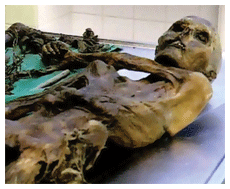
OTZI THE ICE MUMMY

Otzi the Iceman is well naturally preserved mummy of a man. The man who was been captured in Ice was believed to be over 53 centuries old (3300 BC).

How the mummy was found:

The mummy was found by Helmut and Erika Simon a German couple who were hiking the Oetzal Alps on 19th Sep'91. At first the couple thought that it was some mountain climber's mummified remains, but they finally decided to take a photo and report the incident to a nearby lodge caretaker, Markus Pirpamer. He in turn informed the respective authorities.

Discovery of true age:

The body was harshly removed from the ice by some ignorant local authorities, which caused some damages to the mummy. It was taken to a morgue in Innsbruck.Since then it has been in display in South Tyrol Museum of Archaeology in Bolzano, Italy.

Tattoos, Clothes, Equipments:
Otzi was considered to have 57 carbon tattoos in his lower spine,behind his knee and right ankle. All the tattoos were of simple dots and lines. The tattoos were located near acupuncture points.Some scientists believe that these are ancient type of acupuncture and were used to treat otzi for some of the diseases he was suffering from. His clothes were highly sophisticated. He was wearing
A Poncho
A bear fur cap tied with two leather straps
Cloak made of woven grass
Loincloth
Pair of leggings
Belt

Equipments found:
Copper axe with yew handle
Flint knife with ash handle

Cause of death:
At first it was believed that Otzi would have died due to a heavy winter storm. But X-rays, CT scan revealed that an arrowhead has wedged in one of his shoulder when he died. It was alleged that Otzi must have been a victim of a ritual sacrifice.

The theory was inspired by other discoveries such as Tollund Man and Lindow Man.He would have suffered unusual blood loss with no treatment available. He also had several cuts in hands, wrist and chest.

Otzi's Curse:
Influenced by the "Curse of Pharaohs" it was believed that Otzi mummy was cursed. The claim is that the deaths of some main people connected to the discovery and examination of Otzi have died under mystifying conditions. This includes the
Rainer Henn - was on the way to present new findings of the remains. "Head collision car accident."
Kurt Fritz - guided Dr.Henn to the location of Oetzi,Died in a avalanche shortly after that.
Rainer Hölz - created an hour long documentary of Otzi. Died of a brain tumor few months later.
Helmut Simon - discoverer, went for a walk disappeared and was found dead 8 days later.
Tom Loy - ground breaking DNA analysis on the corpse, died of blood clot.

Recent Findings:
Dr. Loy found four DNA samples from Otzi's blood. The theory talks a little prequel to his death, a sequence of events that could have happened before Otzi's struggling death. DNA samples done on Otzi man revealed blood traces of four other people,
One from his knife

Two from the same arrowhead

And a fourth from his coat
The events are understood as Otziwas able to kill two of his rivals with the same arrowhead pulling it successfully out each time. The blood on his coat, should have been his wounded pal whom he had been carrying in this fuss.

Latest studies reveal the cause of his death was not just by blood loss due to the arrow head, but he had received a hard blow from the back of his head. The blow could have been due to a fall or someone hit him hard from behind.

Friday, May 9, 2014

Oldest Bog Body with Skin undamaged

Archaeologists have discovered the remnants of a 4,000-year-old man conserved in an Irish peat bog, staining the oldest European body ever established with skin still unbroken.
The chilly, sodden circumstances of Northern European bogs create low-oxygen, extremely sour environments ideal for body continuation. As an effect, hundreds of "bog bodies" dating reverse thousands of years have been revealed in the state, but many have withered down to habitually skeletons and lean to be quicker to 2,000 years old.


An occupant of middle Ireland's County Laois came diagonally the fresh-looking (Cashel Man)  named for the bog he was found in while milling for peat moss, which is used for a range of ranch purposes, together with animal-bedding and meadow taming.
(All that was visible to start with was a pair of legs below the knees, and a torso), Eamonn Kelly, an archaeologist at the National Museum and lead excavator of the project, wrote in the report. (The body appeared to be naked. Later, it was possible to work out that the torso had been damaged by the milling machine, which also removed the head, neck and left arm.)
The team intended the age of the body using radiometric carbon dating, in which the steady decompose rate of radioactive carbon-14 is used to approximate age based on outstanding levels of carbon-14 in the quiet tissues. Amazed to locate the body was generally 4,000 years old, the team dated the peat over and under the body to prove the results, and came up with about the same age.
The researchers also originated cuts down the man's back that looked like ax wounds. They naked axes capable of producing such wounds within the vicinity of the site.
Given this indication of cruelty, the team completed that the young man had been killed in a sacrament forfeit, a observe generally well-known in later eras, but not well acknowledged in the Early Bronze Age of 2000 B.C., about the time this bog body would've lived.
(All the indications are that the human ruins from Cashel Bog tell of the fate of a young king who, through folly or misadventure, was deemed to have failed to appease the goddess on whose benevolence his people depended, and who paid the ultimate price), Kelly wrote.

Archaeological proof proposes King Solomon's excavation subsists

Archaeologists performing excavations in the south of Israel say they've exposed copper mines old-fashioned to the days of King Solomon.
Copper mines formerly thinking to have been built by early Egyptians in the 13th century B.C. really instigated three centuries later through the control of the legendary King Solomon, they said.
Intellectual study and investigation of materials found in the area -- the Timna Valley in Israel's Aravah Desert -- advocate the mines were operated by the Edomites, a semi-nomadic ethnic amalgamation mentioned in the Bible as warring regularly with Israel, a liberate from the American Friends of Tel Aviv University reported Tuesday.
"The mines are definitely from the period of King Solomon," Tel Aviv archaeology Professor Erez Ben-Yosef said. "They may help us understand the local society, which would have been invisible to us otherwise."
Excavation revealed a massive smelting camp containing the remnants of hundreds of furnaces and layers of copper slag, the waste created during the smelting process.
Cooperation among thousands of people would have been required to operate the mines in the middle of the desert, the researchers said.
(In Timna Valley, we unearthed a society with undoubtedly significant development, organization, and power," Ben-Yosef said. "And yet because the people were living in tents, they would have been transparent to us as archaeologists if they had been engaged in an industry other than mining and smelting, which is very visible archaeologically.)

Copyright © 2014 Archaeology Excavation