Showing posts with label Archaeologists Discover Last Neanderthals. Show all posts

Saturday, June 28, 2014

World Heritage Sites - Mahabodhi Temple at Bodhgaya

Mahabodhi Temple Complex, Bodhgaya (2002), Bihar


Bodh Gaya is associated with the enlightenment of Lord Buddha (566-486 B.C.). The sacred Bodhi tree under which he is believed to have attained enlightenment. The place is highly venerated by the Buddhists. Emperor Asoka visited Bodh Gaya around 260 B.C. and constructed a small temple near the Bodhi tree. An inscription datable to 1st – 2nd century A.D. mentions that the temple of Asoka was replaced by a new one.

Fahien first makes reference to the main temple and the Bodhi tree in 404-05 A.D. Hieun Tsang, who visited the site in 637 A.D. mentions the presence of walls surrounding the Bodhi tree, within which stood the Mahabodhi temple nearly 160 feet tall and a large fine sanctuary. Several additions and alterations took place and the present temple may be datable to the 6th century A.D. The temple fell into disuse in the 13th century A.D. after the conquest of this region by the Delhi Sultanate. During the 19th century, the Burmese kings made certain repairs which were continued by the British in 1880-84.

The temple covers an area of nearly 4.8 hectares and 55 m in height. The sanctum carries a lofty pancharatha sikhara of a straight-edged pyramidal design, demarcated into seven storeys by bhumi-amalakas (amalakas occurring at the corners of the sikhara to denote storeys).

The sacred Bodhi tree stands to the west of the above temple. It is known as the pipal tree (Ficus religiosa) in India. It is believed that this tree is the direct descendant of the original tree under which Lord Buddha meditated.

Tuesday, May 27, 2014

DISCOVERING THE HEART OF PREHISTORIC GALLOWAY

Over the last couple of years, GUARD Archaeology teams led by GUARD Archaeologists Warren Bailie and Kevin Mooney, have discovered a range of prehistoric archaeology spanning 7000 years of activity, during excavations undertaken in advance of the A75 Dunragit Bypass in Dumfries and Galloway in south-west Scotland.

Funded by Transport Scotland and carried out in collaboration with Amey and RJ McLeod, the archaeological remains include the earliest known house in south-west Scotland dating to the Mesolithic period, as well as a Neolithic structure, Neolithic/Early Bronze Age stone lined cists, a Bronze Age cemetery complex and an Iron Age village.

The remains of a Mesolithic house was discovered in an area of criss-crossing palaeochannels, on the edge of a former estuary which existed here throughout prehistory. Radiocarbon dates recovered from the Mesolithic house revealed that this settlement dates to around 6000 BC. A perforated stone adze was found on the Mesolithic site, not a common find on sites of this period and which may have been used to work wood. In excess of 13,500 Mesolithic flint microliths and knapping waste were also recovered, indicating that this site represents a core focus of Mesolithic activity in Dumfries and Galloway. The location here, on a coastal fringe, was probably deliberately chosen by the occupants to exploit readily available resources of fish and shellfish seaward and hunting grounds close at hand in the hinterland.

Neolithic remains were also found, and which may be related to the nearby ceremonial complex at Dunragit, previously excavated by Manchester University between 1999 and 2002. This comprised three concentric rings of timber posts, which had been preceded by a post-defined cursus monument. These remains were first spotted through aerial photography and the only visible part of this ceremonial complex is Droughduil Mote, a prominent conical shaped mound to the south of Dunragit. This was once assumed to be a medieval motte but the Manchester University excavation revealed it to be a Neolithic mound, perhaps used, like the better known Silbury Hill in south-west England, as an elevated platform in ceremonies, before an Early Bronze Age cairn was built on it summit.

The new bypass route was carefully selected to avoid this archaeology and other known archaeological cropmarks, most of which are scheduled monuments. However, amongst the new archaeological remains discovered during the removal of topsoil from the A75 Bypass route, were Neolithic remains perhaps associated with the ceremonial complex.

A Neolithic structure or house was found by the GUARD Archaeology team, constructed of multiple posts and from which amongst the flint and pottery artefacts was found a leaf-shaped flint arrowhead of Neolithic date. This rectilinear structure lay on a ridge overlooking the lower lying area of the Mesolithic site.

On this same ridge the GUARD Archaeology team also recovered two jet necklaces from two separate stone-lined pits or cists, as well as a beaker and food vessel. The jet necklaces are of exceptional quality, made from jet that originated from Yorkshire and are the first such jet necklaces to be found in Galloway, indeed the first such jet necklaces to be found in Scotland in many years.

The Beaker pottery dates to the end of the Neolithic/ beginning of the Bronze Age period and may be linked to the introduction of the Beaker Culture from Europe into south-west Scotland at that time.

No bone survived in either cist, but further post-excavation work is expected to include chemical tests to tell us whether the bodies were removed from their graves or if these were ritual deposits or cenotaphs. These cemeteries appear to have been used over the late third and second millennia BC.

Two Bronze Age cemeteries were also discovered. 20 cremations of likely Bronze Age date were excavated, including three Barrows. Finds from the excavations here included several fragmentary urns and one wholly intact example which contained the cremated remains of an adult. Flint artefacts were also recovered and one of particular interest was a very finely serrated transverse flint blade

The remains of six Iron Age round-houses were also discovered. Known Iron Age settlements in Galloway tend to be enclosed by palisades or ramparts and found predominantly on hilltops, higher ground, coastal promontories or lochs, forming defended duns, hill forts, promontory forts or crannogs. Unenclosed settlements of the Iron Age tend to comprise single houses, but the Dunragit settlement is unusual in appearing to be a large unenclosed settlement on low-lying ground.

It is only the second such Iron Age village to be found in Galloway, a previous one being discovered last year on the banks of the Black Loch of Myrton in the Machars. Iron Age pottery, which is not normally found on Iron Age settlements in Galloway was recovered from the Dunragit round-houses, as well as a Romano-British Iron Age brooch and evidence of metalworking. While radiocarbon dating has still to be undertaken, the artefacts indicate occupation of this settlement around two thousand years ago.

It is not certain if the Romans had a specific positive or negative influence on this community but the settlement appears to have been occupied during the Roman occupation in the early centuries AD and a Roman road passes close by.

GUARD Archaeology’s post-excavation work on these finds is due to commence soon, but the wealth of unforeseen finds recovered from Dunragit is likely to reveal new insights into prehistoric Scotland from the Mesolithic to the Iron Age eras, encompassing a range of ceremonial, burial and domestic structures and activities, and revealing the development, transformation and demise of a densely occupied prehistoric landscape.

Monday, May 26, 2014

Richard III to be reburied in Leicester

The remains of Richard III are to be re-interred in Leicester Cathedral – likely next spring – a judicial review concluded today (23 May).


Addressing crowds of journalists in the cathedral, shortly after the High Court handed down their decision at 10am, the Rt Rvd Tim Stevens, Bishop of Leicester, announced that the judges had ruled that the Ministry of Justice license granted at the outset of the University of Leicester’s excavations on the Grey Friars site (see CA 272 for more on this project),  - which stated that, if found, Richard’s bones would be reburied in Leicester Cathedral – should be upheld.

The license had been contested as, after the identity of the skeleton had been confirmed (see CA 277), the Plantagenet Alliance, a group of 15 distant relatives of the king, argued that there should have been wider consultation before Richard’s final resting place was determined. But now, following nine weeks of deliberation, their legal challenge has been dismissed.

‘We are of course delighted that the ruling has gone in our favour – we can now begin planning for the re-interment to proceed with dignity and honour, ‘ said Bishop Stevens.

He went on to read out a postscript that the judges had appended to their ruling:


‘Since Richard III’s exhumation on 5 September 2012, passions have been roused and much ink has been spilt. Issues relating to his life and death and place of re-interment have been exhaustively examined and debated. The Very Reverend David Monteith, the Dean of Leicester Cathedral, has explained the considerable efforts and expenditure invested by the Cathedral in order to create a lasting burial place “as befits an annointed king”. We agree that it is time for Richard III to be given a dignified reburial, and finally laid to rest. ‘

Dean David Monteith added that he hoped the ceremonies surrounding Richard’s re-interment would help to foster a spirit of cooperation and reconciliation between differing parties.

‘Wherever you sat on this matter, everyone is welcome to participate in what comes next,’ he said. ‘We are going to lay a man and an annointed king to rest, and we should do this as one community and one nation working together to ensure it is done with dignity and honour. ‘

Plans for the reburial itself are still in progress, though it is expected that the ceremony will involve events over four or five days, during which Richard’s remains will be taken back to Bosworth battlefield, before being processed back into Leicester via a number of sites associated with the battle, and churchyards where other people killed on that day are buried.

Richard III will then lie in state in the cathedral for a number of days to allow members of the public to pay their respects, after which he will be buried in a tomb (the revised design of which is to be unveiled in 3-4 weeks) just a few feet from the ledger stone currently dedicated to him in the cathedral’s choir.

‘The cathedral is a working building so the location of the tomb had to allow for the circulation of people, and the performance of services, ‘ said Richard Buckley of University of Leicester Archaeological Services (ULAS), who directed the Grey Friars Project. ‘The choir is also the part of the church where Richard was originally buried at Grey Friars, but the new location is a definite upgrade: before, he had been laid to rest in a place of ambiguous honour – he was only just inside the choir, about as far from the altar as you can get, and hidden away in a part of the church that the public did not have access to. But now he will be at the eastern end of the choir, very close to the altar – it is a much more honourable position.’

The judges’ ruling also sets an important precedent for future archaeological work, he added.

‘It is normal practice, when excavating burials that are around 100 years old or less, to advertise in the local press to give close relatives the right to come forward and be consulted before exhumation, ‘ he said. ‘But with Richard III’s remains, the bones were over 500 years old, so normally you wouldn’t be expected to consult on them. Our worry was that, if the review had gone against us, in future excavations we would be looking at a situation where, if any earlier burials were found to be identifiable, whether at the excavation or analysis stage, we would potentially have to consult all of their relatives – that would just be unworkable. You can imagine, we are very relieved that the result has gone the way it did!’

The Excitement of Hands-on Archaeology

Nothing beats the excitement of hands-on archaeology, and with the new digging season almost upon us, there is no time to lose.

This is a chance to get practical experience, either before heading off to university, or putting into practice what has been studied in theory. But for most, this is simply a glorious way to pass the time.

Our guide covers the full gamut of locations, periods, and types: from fieldwalking to recording and cataloguing, from early Neolithic to Medieval and later – there is something for everyone. Some jobs require stamina, but many do not. Young or old, fit or not, time rich or time poor, all you need is enthusiasm and a desire to get involved.

Use the options below to sort the digs by area, by cost, or by time period – whatever your budget or area of interest, there will be something to suit you. If you don’t have much time to spare try the ‘Dig for a Day’ list, or ‘All Inclusive’ if you want food and accommodation within the cost. There is also an Advice and Useful Info page that will help you know what to expect, along with advice from both diggers and supervisors, as well as a handy checklist so nothing gets forgotten!

So, if you are passionate about Prehistory, interested in the Iron Age, ruminating about Romans, or looking for a new angle on the Saxons, get out into the fresh air and discover…who knows what?

In your complete guide to archaeological excavations around the country, there is no excuse not to join in: look through our list of digs, find one that suits you – then enjoy getting dirty digging up the past!

Saturday, May 17, 2014

Exclusive: Found after 500 years, the wreck of Christopher Columbus’s flagship the Santa Maria


The wreck of the ‘Santa Maria’, as envisaged in 1492

Shipwreck found off coast of Haiti thought to be one of the most significant underwater discoveries in history
More than five centuries after Christopher Columbus’s flagship, the Santa Maria, was wrecked in the Caribbean, archaeological investigators think they may have discovered the vessel’s long-lost remains – lying at the bottom of the sea off the north coast of Haiti. It’s likely to be one of the world’s most important underwater archaeological discoveries.

“All the geographical, underwater topography and archaeological evidence strongly suggests that this wreck is Columbus’ famous flagship, the Santa Maria,” said the leader of a recent reconnaissance expedition to the site, one of America’s top underwater archaeological investigators, Barry Clifford. 

“The Haitian government has been extremely helpful – and we now need to continue working  with them to carry out a detailed archaeological excavation of the wreck,” he said.

So far, Mr Clifford’s team has carried out purely non-invasive survey work at the site – measuring and photographing it.

Tentatively identifying the wreck as the Santa Maria has been made possible by quite separate discoveries made by other archaeologists in 2003 suggesting the probable location of Columbus’ fort relatively nearby. Armed with this new information about the location of the fort, Clifford was able to use data in  Christopher Columbus’ diary to work out where the wreck should be.

An expedition, mounted by his team a decade ago, had already found and photographed the wreck – but had not, at that stage, realized its probable identity.

It’s a current re-examination of underwater photographs from that initial survey (carried out back in 2003), combined with data from recent reconnaissance dives on the site (carried out by Clifford’s team earlier this month), that have allowed Clifford to tentatively identify the wreck as that of the Santa Maria.

The evidence so far is substantial. It is the right location in terms of how Christopher Columbus, writing in his diary, described the wreck in relation to his fort.

The site is also an exact match in terms of historical knowledge about the underwater topography associated with the loss of the Santa Maria. The local currents are  also consistent with what is known historically about the way the vessel drifted immediately prior to its demise.

The footprint of the wreck, represented by the pile of ship’s ballast, is also exactly what one would expect from a vessel the size of the Santa Maria.

Using marine magnetometers, side-scan sonar equipment and divers, Mr. Clifford’s team has, over several years, investigated more than 400 seabed anomalies off the north coast of Haiti and has narrowed the search for the Santa Maria down to the tiny area where the wreck, which the team thinks may well be Columbus’ lost vessel, has been found.

Friday, May 16, 2014

The discovery of Machu Picchu

The spectacular ‘lost city of the Incas’ high among the Andes mountains in Peru attracts so many visitors today and their presence causes so much damage that a limit has had to be put on their numbers. Hiram Bingham, the man who first revealed it to the world, was a buccaneering American explorer, born in Hawaii in 1875. His parents were missionaries and hoped he would follow in their footsteps, but his youthful efforts to do so made him feel physically sick and he preferred playing American football. Educated privately in New England, he went to Yale University in 1894 to embark on an academic career. He was strongly interested in Latin American history and studied for his PhD in it at Harvard. Fortunately for him and the
world at large in 1900 he married – to her parents’ dismay – a girl called Alfreda Mitchell. She was an heiress to the Tiffany jewellery fortune and Bingham used her money to travel in South America. He was appointed a lecturer at Yale but found exploring far more interesting than teaching. His enthusiasm for exploring extended to women as well and he took full advantage of his travels away from home.

In 1906 Bingham traced Simon Bolivar’s routes through Venezuela and Columbia in the 1820s. In 1909 he explored historic South American trade routes and took the old one from Buenos Aires to Lima in Peru, going on to Cuzco. In 1911 he led a small expedition to Peru in search of the ‘lost city’ of  Vilcabamba, the last refuge of the Inca Manco Capac II, who fought against the Spanish conquerors in the 1530s. This took Bingham and his party of seven to Cuzco and from there by mule and on foot to a small settlement called Mandor Pampa, near Aguas Calientes, where they encountered a local farmer named Melchor Arteaga. Through Bingham’s policeman-interpreter, Arteaga told him that there were extensive ruins high in the mountains nearby at what Arteaga in his native Quechua called Machu Picchu, meaning "old mountain".

They climbed up to the ruins next morning through a persistent drizzle of rain. No one else in Bingham’s party showed any interest, but Bingham, Arteaga and the interpreter spent two exhausting hours clambering up the mountain to a small hut occupied by peasants who were growing crops there. They greeted the American hospitably and deputed a small boy to show him the astonishing things close by. They soon came to what Bingham called ‘an unexpected sight, a great flight of beautifully constructed stone terraces, perhaps a hundred of them, each hundreds of feet long and 10 feet high.’ They continued along one of the terraces: ‘Suddenly I found myself confronted with the walls of ruined houses built of the finest quality of Inca stonework.’ The ruins were overgrown by trees, bamboo thickets and tangles of vines and covered with moss, but the white granite walls were ‘carefully cut and exquisitely fitted together’ and the scene ‘fairly took my breath away.’

Bingham was sure he had discovered Vilcabamba. He believed that to the end of his life, mistakenly as it turned out, and he was fascinated by the mystery and magic of the place, with the great snowy peaks looming above it. Returning in succeeding years he took thousands of photographs. He also took thousands of objects to the United States for study and safekeeping, which was to cause wrangling between the Peruvian government and Yale University for years afterwards.

After the First World War Bingham went into politics in Connecticut and was US senator for the state at the turn of the 1920s and 1930s. He and Alfreda had seven children but by 1937 she could stand his persistent infidelity no longer and divorced him. In the 1950s he had a controversial role as head of President Truman’s new Loyalty Review Board, which made it easier to dismiss civil servants for Communist sympathies. He died in Washington DC at the age of 80 in 1956.

The Spanish conquistadors never saw Machu Picchu and consequently never wrote about it. A few other outsiders had seen it in the years before Bingham, but he was the one who revealed it to the world at large and it made him famous. He has a moon crater named after him and the character of Indiana Jones is thought to owe something to him but he is not highly regarded by scholars. He was not trained in archaeology, his theories were wrong and the real Vilcabamba was discovered by another American explorer, Gene Savoy, in 1964. Machu Picchu is now believed to have been the mountain retreat of the great Inca emperor Pachacutec (‘He who Shakes the Earth’), abandoned at some point after his death in 1472.

Thursday, May 15, 2014

Howard Carter- 138th Birthday

Howard Carter (9 May 1874 – 2 March 1939) was an English archaeologist and Egyptology who became world famous after discovering the intact tomb of 14th-century BC pharaoh Tutankhamen (colloquially known as "King Tut" and "the boy king").


Howard Carter was born in London, the son of Samuel Carter, an artist, and of Martha Joyce Carter. His father trained and developed Howard's artistic talents.

Howard Carter spent much of his childhood with relatives in the Norfolk market town of Swaffham, the birthplace of both his parents.[1][2] In 1891 the Egypt Exploration Fund (EEF) sent Carter to assist Percy Newberry in the excavation and recording of Middle Kingdom tombs at Beni Hasan.

Although only 17, Carter was innovative in improving the methods of copying tomb decoration. In 1892 he worked under the tutelage of Flinders Petrie for one season at Amarna, the capital founded by the pharaoh Akhenaten. From 1894 to 1899 he worked with Édouard Naville at Deir el-Bahari, where he recorded the wall reliefs in the temple of Hatshepsut.

In 1899, Carter was appointed as the first chief inspector of the Egyptian Antiquities Service (EAS). He supervised a number of excavations at Thebes (now known as Luxor). In 1904 he was transferred to the Inspectorate of Lower Egypt. Carter was praised for his improvements in the protection of, and accessibility to, existing excavation sites,[3] and his development of a grid-block system for searching for tombs. The Antiquities Service also provided funding for Carter to head his own excavation projects and during this period Carter discovered the Tombs of Thutmose I and Thutmose III, although both tombs had been robbed of treasures long before.

Carter resigned from the Antiquities Service in 1905 after formal inquiry into what became known as the Saqqara Affair, a noisy confrontation between Egyptian site guards and a group of French tourists. Carter sided with the Egyptian personnel.

Tutankhamun's tomb

After three hard years for Carter, in 1907 Lord Carnarvon employed Carter to supervise Carnarvon's Egyptian excavations in the Valley of the Kings.[6] The intention of Gaston Maspero, who introduced the two, was to ensure that Howard Carter imposed modern archaeological methods and systems of recording.

After several years of finding little, Lord Carnarvon (Carter's benefactor) became dissatisfied with the lack of results. In 1922, Carnarvon informed Carter he had one more season of funding to search the Valley of the Kings and find the tomb.

Carnarvon financed Carter's work in the Valley of the Kings to 1914, but until 1917 excavations and study were interrupted by World War I. Following the end of World War I, Carter aggressively resumed his work.
On November 4, 1922, Howard Carter's excavation group found steps Carter hoped led to Tutankhamen tomb (subsequently designated KV62) (the tomb that would be considered the best preserved and most intact pharaonic tomb ever found in the Valley of the Kings).

He wired Lord Carnarvon to come, and on 26 November 1922, with Carnarvon, Carnarvon's daughter and others in attendance, Carter made the "tiny breach in the top left hand corner" of the doorway, and was able to peer in by the light of a candle and see that many of the gold and ebony treasures were still in place. He made the breach into the tomb with a chisel his grandmother had given him for his seventeenth birthday. He did not yet know at that point whether it was "a tomb or merely a cache", but he did see a promising sealed doorway between two sentinel statues. When Carnarvon asked "Can you see anything?", Carter replied with the famous words: "Yes, wonderful things."

The next several months were spent cataloging the contents of the antechamber under the "often stressful"
oversight of Pierre Lacau, director general of the Department of Antiquities of Egypt.On 16 February 1923, Carter opened the sealed doorway, and found that it did indeed lead to a burial chamber, and he got his first glimpse of the sarcophagus of Tutankhamun. All of these discoveries were eagerly covered by the world's press, but most of their representatives were kept in their hotels; only H. V. Morton was allowed on the scene, and his vivid descriptions helped to cement Carter's reputation with the British public.

Carter's own notes and photographic evidence, indicate that he, Lord Carnarvon and Lady Evelyn Herbert entered the burial chamber shortly after the tomb's discovery and before the official opening.

 Death

The clearance of the tomb with its thousands of objects continued until 1932. Following his sensational discovery, Howard Carter retired from archaeology and became a part-time agent for collectors and museums, including the Cleveland Museum of Art and the Detroit Institute of Arts. He visited the United States in 1924, and gave a series of illustrated lectures in New York City and other cities in the United States that were attended by very large and enthusiastic audiences, sparking Egyptomania in America.

He died of lymphoma in Kensington, London, on 2 March 1939 at the age of 64.The archaeologist's natural death so long after the opening of the tomb, despite being the leader of the expedition, is the piece of evidence most commonly put forward by sceptics to refute the idea of a "curse of the pharaohs" plaguing the party that might have "violated" Tutankhamun's tomb.

Carter is now buried in Putney Vale Cemetery in London.On his gravestone is written: "May your spirit live, May you spend millions of years, You who love Thebes, Sitting with your face to the north wind, Your eyes beholding happiness" and "O night, spread thy wings over me as the imperishable stars".


Sunday, May 11, 2014

Amesbury Archer

Amesbury Archer (or King of Stonehenge) is an early Bronze Age man. His finding dates to back to 2300 BC. His grave was discovered in May 2002 by the archaeologists from Wessex Archaeology, in Amesbury, WiltShire, England near the Stonehenge. His grave is of particular importance because of the rich valuables and the earliest gold objects ever found in England. Nearly 100 objects were found along with the complete skeleton of the man. It is believed that the objects buried in with his grave was for his use in his next life.

Amesbury Archer Recent research using lead isotope analysis identified the origin of the man as being Central Europe. He is believed to have been one of the earliest metalworkers in Britain. He is nicknamed the "ARCHER" or "King of Stonehenge" because a longbow was among the artifacts buried with him.


The importance of the discovery of the Amesbury archer:
First example of a most dominant elite
Could have been involved in the Erection of the Stonehenge
His grave contained the richest number of items
The gold used in his earrings or otherwise would be hair tresses dated back to 2470 BC


Importance Of discovery of Amesbury Archer in ancient archaeology
The Amesbury Archer is important for many reasons. This was a time when the first metals were brought to Britain, and the Archer was buried with two gold hair tresses which are the oldest securely dated gold still found in Britain (dated to around 2,400BC).

The Archer was important for another reason: he was buried three miles from Stonehenge at the very time when the massive stones were being brought to Salisbury Plain in Wiltshire to erect the world-famous monument. The Archer is essential because he is the first example of a powerful elite who may well have organized the erection of Stonehenge.

His grave is of particular importance because of its associates with multicultural Europe and early copper smelting technology. He is trusted to have been one of the earliest metalworkers in Britain.


The Amesbury Archer goes on display

Display of amesbury archer at Salisbury Museum A permanent display for the Amesbury Archer skeleton
and grave goods was built by conservators at the Conservation Service laboratory. The display is planned to represent the burial environment in which the Archer was found and replicates it as far as achievable.

A custom-built case, already in place in the Early Man Gallery at Salisbury & South Wiltshire Museum, houses the final grave display.

The burial consists of a box made from medium density fiberboard (MDF). This has been painted with a coating of a special protective varnish to seal the surface. An aluminum mesh has been clipped to the MDF and padded with acid free tissue behind to represent the uneven nature of the soil in the burial atmosphere. This was then covered with a fabric layer before a layer of plaster was added over the top. This surface was then painted with an acrylic emulsion to represent the grave surface.

The burial was built in two halves so that it could be easily transported to the museum and assembled. It can also be dismantled easily if necessary. The grave will form a permanent display area for the Amesbury Archer in the Early Man Gallery at Salisbury & South Wilts Museum and can be sighted daily.


The First Burial Of Amesbury Archer 

First burial of Amesbury archer with artefacts explained Amesbury Archer grave had the greatest number of objects ever found in a British Bronze Age burial.

The following are the objects found in burial.
Three tiny copper knives, more for illustrate than for violent use.
16 barbed flint arrowheads .Scattered through the grave but at a slightly higher level were 16 barbed and tangled arrowheads. The height at which the arrowheads were found hint that they were lying over the body rather than having been located on the floor of the grave.
A kit of flint-napping.
And metalworking tools, including cushion stones that purposed as a kind of moveable anvil and that recommend he was a coppersmith and some boar's tusks.
On his forearm was a black Stone wrist-guard. A similar red wrist-guard was by his knees. With the second wrist-guard were a shale belt ring and a pair of gold hair ornaments.

Dr. Andrew Fitzpatrick quotes: We have long suspected that it was people from the continent of Europe who initiated the trade that first brought copper and gold to Britain and the Archer is the first discovery to confirm this.


The second burial site of Amesbury Archer 

Another grave was found close to the Amesbury Archers - Second burial site Another grave was found
close to the Amesbury Archer's.
The bones were being cleaned in the laboratory, the discovery of a pair of gold hair tresses inside the man's jaw.
The new hair tresses were in the same style as the Archer's.
A study of the bones later illustrated that he and the Archer were related as they both had the same extraordinary bone structure in their feet.

Study of the two men's skeletons exposed that they shared an unusual characteristic, but one that was maybe unknown to them. Some bones at the top of their insteps that are not usually expressed are articulated. This would not have caused them any problem, but this trait is very rare. To find two individuals who share it, buried so closely to each other, strongly suggests that they were related.
Radiocarbon dates propose that the second burial is slightly later than the Archer's, but whether they were brothers, cousins, or father and son, is not known.


The Beaker from the grave of the Amesbury Archer 

Amesbury Archer Beakers found at the grave The five Beaker pots from the grave are an outstanding group,
both in terms of number of vessels and quality. No other burial has lots of Beaker pots as grave goods, the most common number of Beakers in a grave being one. The pair of pots in front of the Archer's face is almost alike. Both pots are ornamented with horizontal lines of ver fine plaited cord, pressed into the clay when damp. This is a remarkable form of cord decoration in both Britain and Europe.


Weapons Used By Amesbury Archer

Arrowheads sited at Fist burial site An antler spatula for working flints, another copper knife and more flints
- these would have been tools, some in mint condition.
Approximately the archer's waist and legs were 15 arrowheads, signifying that a quiver of hafted arrows had been scattered over his lower body and legs, but the bow had long since rotted away.
It is likely that the items were located in the Archer's grave for his use in the next life. He had everything that a person would need to stay alive - clothing, tools, weapons, pottery and spare flints to make new tools.

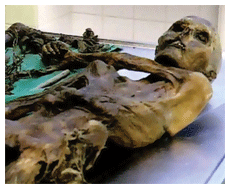
OTZI THE ICE MUMMY

Otzi the Iceman is well naturally preserved mummy of a man. The man who was been captured in Ice was believed to be over 53 centuries old (3300 BC).

How the mummy was found:

The mummy was found by Helmut and Erika Simon a German couple who were hiking the Oetzal Alps on 19th Sep'91. At first the couple thought that it was some mountain climber's mummified remains, but they finally decided to take a photo and report the incident to a nearby lodge caretaker, Markus Pirpamer. He in turn informed the respective authorities.

Discovery of true age:

The body was harshly removed from the ice by some ignorant local authorities, which caused some damages to the mummy. It was taken to a morgue in Innsbruck.Since then it has been in display in South Tyrol Museum of Archaeology in Bolzano, Italy.

Tattoos, Clothes, Equipments:
Otzi was considered to have 57 carbon tattoos in his lower spine,behind his knee and right ankle. All the tattoos were of simple dots and lines. The tattoos were located near acupuncture points.Some scientists believe that these are ancient type of acupuncture and were used to treat otzi for some of the diseases he was suffering from. His clothes were highly sophisticated. He was wearing
A Poncho
A bear fur cap tied with two leather straps
Cloak made of woven grass
Loincloth
Pair of leggings
Belt

Equipments found:
Copper axe with yew handle
Flint knife with ash handle

Cause of death:
At first it was believed that Otzi would have died due to a heavy winter storm. But X-rays, CT scan revealed that an arrowhead has wedged in one of his shoulder when he died. It was alleged that Otzi must have been a victim of a ritual sacrifice.

The theory was inspired by other discoveries such as Tollund Man and Lindow Man.He would have suffered unusual blood loss with no treatment available. He also had several cuts in hands, wrist and chest.

Otzi's Curse:
Influenced by the "Curse of Pharaohs" it was believed that Otzi mummy was cursed. The claim is that the deaths of some main people connected to the discovery and examination of Otzi have died under mystifying conditions. This includes the
Rainer Henn - was on the way to present new findings of the remains. "Head collision car accident."
Kurt Fritz - guided Dr.Henn to the location of Oetzi,Died in a avalanche shortly after that.
Rainer Hölz - created an hour long documentary of Otzi. Died of a brain tumor few months later.
Helmut Simon - discoverer, went for a walk disappeared and was found dead 8 days later.
Tom Loy - ground breaking DNA analysis on the corpse, died of blood clot.

Recent Findings:
Dr. Loy found four DNA samples from Otzi's blood. The theory talks a little prequel to his death, a sequence of events that could have happened before Otzi's struggling death. DNA samples done on Otzi man revealed blood traces of four other people,
One from his knife

Two from the same arrowhead

And a fourth from his coat
The events are understood as Otziwas able to kill two of his rivals with the same arrowhead pulling it successfully out each time. The blood on his coat, should have been his wounded pal whom he had been carrying in this fuss.

Latest studies reveal the cause of his death was not just by blood loss due to the arrow head, but he had received a hard blow from the back of his head. The blow could have been due to a fall or someone hit him hard from behind.

Friday, May 9, 2014

Oldest Bog Body with Skin undamaged

Archaeologists have discovered the remnants of a 4,000-year-old man conserved in an Irish peat bog, staining the oldest European body ever established with skin still unbroken.
The chilly, sodden circumstances of Northern European bogs create low-oxygen, extremely sour environments ideal for body continuation. As an effect, hundreds of "bog bodies" dating reverse thousands of years have been revealed in the state, but many have withered down to habitually skeletons and lean to be quicker to 2,000 years old.


An occupant of middle Ireland's County Laois came diagonally the fresh-looking (Cashel Man)  named for the bog he was found in while milling for peat moss, which is used for a range of ranch purposes, together with animal-bedding and meadow taming.
(All that was visible to start with was a pair of legs below the knees, and a torso), Eamonn Kelly, an archaeologist at the National Museum and lead excavator of the project, wrote in the report. (The body appeared to be naked. Later, it was possible to work out that the torso had been damaged by the milling machine, which also removed the head, neck and left arm.)
The team intended the age of the body using radiometric carbon dating, in which the steady decompose rate of radioactive carbon-14 is used to approximate age based on outstanding levels of carbon-14 in the quiet tissues. Amazed to locate the body was generally 4,000 years old, the team dated the peat over and under the body to prove the results, and came up with about the same age.
The researchers also originated cuts down the man's back that looked like ax wounds. They naked axes capable of producing such wounds within the vicinity of the site.
Given this indication of cruelty, the team completed that the young man had been killed in a sacrament forfeit, a observe generally well-known in later eras, but not well acknowledged in the Early Bronze Age of 2000 B.C., about the time this bog body would've lived.
(All the indications are that the human ruins from Cashel Bog tell of the fate of a young king who, through folly or misadventure, was deemed to have failed to appease the goddess on whose benevolence his people depended, and who paid the ultimate price), Kelly wrote.

Archaeological proof proposes King Solomon's excavation subsists

Archaeologists performing excavations in the south of Israel say they've exposed copper mines old-fashioned to the days of King Solomon.
Copper mines formerly thinking to have been built by early Egyptians in the 13th century B.C. really instigated three centuries later through the control of the legendary King Solomon, they said.
Intellectual study and investigation of materials found in the area -- the Timna Valley in Israel's Aravah Desert -- advocate the mines were operated by the Edomites, a semi-nomadic ethnic amalgamation mentioned in the Bible as warring regularly with Israel, a liberate from the American Friends of Tel Aviv University reported Tuesday.
"The mines are definitely from the period of King Solomon," Tel Aviv archaeology Professor Erez Ben-Yosef said. "They may help us understand the local society, which would have been invisible to us otherwise."
Excavation revealed a massive smelting camp containing the remnants of hundreds of furnaces and layers of copper slag, the waste created during the smelting process.
Cooperation among thousands of people would have been required to operate the mines in the middle of the desert, the researchers said.
(In Timna Valley, we unearthed a society with undoubtedly significant development, organization, and power," Ben-Yosef said. "And yet because the people were living in tents, they would have been transparent to us as archaeologists if they had been engaged in an industry other than mining and smelting, which is very visible archaeologically.)

Treasure near Temple Mount

Archaeologists have made what they're describing as a historic find at the foot of Jerusalem's Temple Mount gold coins and jewelry that hearken back 1,400 years.
"This happens only once in a lifetime," said the lead digger, Eilat Mazar, with the Hebrew University of Jerusalem, in NBC.
Among the discoveries: a 4-inch-wide medallion etched with a seven-branched menorah, a ram's horn and a Torah scroll; 36 coins; and a variety of gold and silver jewelry, including large gold earrings and a gold-plated silver hexagonal prism.
"The 36 gold coins can be dated to the reigns of different Byzantine emperors, ranging from the middle of the fourth century CE to the early century CE," said Lior Sand berg, a coin specialist with the Hebrew University's Institute of Archaeology, in NBC.
The pieces were discovered just feet from the southern wall of the Temple Mount, one of the world's most sacred holy sites that are claimed by three different religions Christianity, Judaism and Islam.
The archaeologist team made the find this spring and set to work to remove the treasures. They announced the discovery this week at a press conference near the site.

Archaeologists Discover Last Neanderthals

Archaeologists have finished an important discover on a promontory to assist illustrate the home of the last Neanderthals in northwest Europe.
An archaeological excavate at Le Cotte de St Brelade in Brelade, Jersey, unearthed items which divulge the existence of Stone Age hunters at the bluff, The Register reported.
"In terms of the volume of residue, archaeological prosperity and deepness of time, there is nil else like it known in the British Isles," said Dr Matt Pope of the Institute of Archaeology at University College London, a research leader.
"Given that we consideration these deposits had been detached completely by earlier researchers, ruling that so much still leftovers is as thrilling as discovering a new site."
The site, which is off the coast of Normandy, France, has exposed more Neanderthal stone tools than the rest of the British Isles simultaneously. It holds the only known late caveman remains in Northwest Europe and an imminent into the early relatives of early human beings.
The archaeologists dated sediments at the cave site using a technique called optically enthused luminescence, which events the last time sand grains were uncovered to sunlight.
Dr Pope said the results showed that part of the succession of sediments dates between 100,000 and 47,000 years old, representing that Neanderthal teeth which were exposed at the site in 1910 were younger than earlier thought, and "doubtless belonged to one of the last Neanderthals to live in the region".

For more interesting topics related to archaeology, visit archaeology excavation.
Copyright © 2014 Archaeology Excavation