Showing posts with label Fatehpur Sikri. Show all posts

Saturday, July 26, 2014

Evidence of mahabharata : Shri Krishna's Dwarka submerged in 1443 BC found in archaeology survey india

For thousands of years, we Indians have believed in the divinity of Shri Krishna. For us he was a Karmayogi par excellence who gave us action oriented philosophy of life in the form of Bhagavad Gita. But questions have constantly haunted us as to whether Shri Krishna was a historical character or is a mythical character and whether war of Mahabharata was actually fought or was it great poet Vyasa’s imagination.

Till recent past we did not have the wherewithal to search for and establish the truth. But modern scientific tools and techniques like computers with planetarium softwares, advancements in archaeological and marine archaeological techniques, earth-sensing satellite photography and thermoluminescence dating methods, all have made it possible to establish the authenticity and dating of many events narrated in ancient texts like Mahabharata. Recent archaeo-astronomical studies, results of marine-archaeological explorations and overwhelming archaeological evidence have established the historicity and dating of many events narrated in the epic Mahabharata. These have led to the conclusion that Mahabharata War was actually fought in 1478 BC and Shri Krishna’s Dwarka City got submerged under the sea in 1443 BC.

Astronomical Evidence - In the Mahabharata references to sequential solar and lunar eclipses as also references to some celestial observations have been made. Dr. R.N.Iyengar, the great scientist of Indian Institute of Science, Bangalore examined relevant references and searched for the compatible dates by making use of planetarium software (PVIS and EZC). He concluded that most of these references were internally consistent and that the eclipses and celestial observations of Mahabharata belong to the period 1493 BC - 1443 BC of Indian History. (refer Indian Journal of History of Science/38.2/2003/77-115).

In the Mahabharata there are references to three sequential solar eclipses and to some other planetary positions. Reference to the first solar eclipse comes in the Sabha Parva (79.29), graphically described by Vidur when Pandavas start their journey to the forest on being banished for 12 years of life in exile and one year of life incognito after they had lost everything in the game of dice. After 13 years of exile and incognito life, Pandavas came back to Hastinapur and they demanded their kingdom back but Duryodhana refused. Several efforts to prevent war failed and war became imminent. There is a reference to the second solar eclipse in the Bhisma Parva (3.29), following a lunar eclipse occurring within the same fortnight a few days before the actual war of Mahabharata. These eclipses occurred after 14-15 years of the first solar eclipse The epic also refers to some unfavourable planetary positions between the second solar eclipse and the beginning of the war on Kartika Purnima (Bhisma Parva 3.14 to 3.19). On Kartika Krishna Ashtami, Saturn was near Rohini and Mars was between Jayestha and Anuradha. Twenty two days later, on Kartika Purnima, Saturn was near Rohini, Mars was near Jayestha, a rough planet (probably uranus) was between Citra and Swati. Another white planet (possibly Jupiter) had moved from Purva-bhadra to Uttar-bhadra. Reference to the third solar eclipse comes in the Mausala Parva (2.19 to 2.20) occurring in the 36th year of the Mahabharata War. This was visible from the city of Dwarka which is stated to have been subsequently submerged under the sea. For these observations to be internally consistent, there should had been three solar eclipses within a period of 50 years. The first one and the second one after a gap of 14-15 years should have been visible from Kurukshetra whereas the third solar eclipse should have been visible from Dwarka after 35 years of the second one.

From references to these eclipses and celestial observations Dr. Iyengar prepared the list of compatible dates and concluded that these eclipses alongwith the stated planetary positions were observable during the period 1493 BC - 1443 BC because the planetarium software shows that:

(i) On 19.3.1493 BC there was solar eclipse visible from Kurukshetra.

(ii) After about 15 years, on 1st June, 1478 BC, there was a solar eclipse visible from Kurukshetra which was preceded by a lunar eclipse during the same fortnight on 16th May 1478 BC.

(iii) About 3 months later, there was Kartika Krishna Ashtami on 20.9.1478 BC when Saturn was near Rohini (in Bhar-Kritika) and Mars was between Jayestha and Anuradha.

(iv) Three weeks later, on 12.10.1478 BC, there was Kartika Purnima when the war actually started. On that day, Saturn was still near Rohini (as it actually moved from Bhar Kritt to Rohini between 1.6.1478 BC to 10.11.1478 BC). Mars was near Jayestha. Uranus, which probably is referred to as rough planet, was between Citra and Swati. Jupiter had moved from Purva-bhadra to Uttar-bhadra on 12.10.1478 BC.

(v) In the 36th year after Mahabharata war in October 1478 BC, a solar eclipse could be seen from Dwarka on 7.1.1443 BC.

Thus as per archaeo-astronomical calculations, Mahabharata War was fought in 1478 BC and Dwarka City got submerged in 1443 BC. These conclusions arrived at are corroborated by marine archeologists, archeologists as well as by the historians who have analysed the genealogy charts of rulers given in Puranas.

Marine Archaeological explorations around Dwarka - The on-shore and off-shore explorations carried out in and around Dwarka during last 50 years have revealed that Dwarka was a prosperous city in ancient times which was destroyed and reconstructed several times. The work of great excavators like Shri Z.D.Ansari and Shri M.S.Mate and chance discovery of temples of 9th century AD and 1st century AD buried near the present Dwarkadhish Temple prompted setting of a Marine Archaeology Centre jointly by National Institute of Oceanography (NIO) and Archaeological Survey of India (ASI). A project for marine archaeological explorations in Dwarka was initiated under the dynamic leadership of great marine archaeologist Dr. S.R.Rao who has the distinction of being awarded “The World Ship Trust Award” for outstanding research done in this field.

Dr. S.R.Rao’s team consisted of expert under-water explorers, trained diver-photographers and experienced archaeologists. The technique of geophysical survey was combined with the use of echo-sounders, mud-penetrators, sub-bottom profilers and under-water metal detectors. This team carried out twelve marine archaeological expeditions between the year 1983 to 1992 AD and articles/antiquities recovered were sent to Physical Research Laboratory for dating. By using thermoluminescence, carbon dating and other modern scientific techniques, artifacts were found to be belonging to the period 15th century BC to 18th century BC. In his great work “The Lost City of Dwarka”, Dr. S.R.Rao has given graphic and scientific details of these discoveries and artifacts. He has concluded that:

(i) The land for building the city of Dwarka had been reclaimed from the sea between 16th to 15th century BC and a fortified city was built on boulder packing with outer gateway to the sea and inner gateway to Gomti river. This corroborates the references in the Epic Mahabharata as per which Dwarka city was built by Shri Krishna after reclaiming the land from the sea and it was built only a few years before the Game of Dice in 1493 BC.


(ii) The thermoluminescence dating of lustrous Redware Pottery items found during explorations revealed that these were 3520 years old i.e. around 16th-15th century BC.

(iii) The most famous rectangular seal with engraved motifs of bull, unicorn and goat found in trench UW6 in the sea bed was dated as belonging to 16th century BC. The seal corroborates the references made in the ancient manuscripts that every citizen of Dwarka was required to carry a mudra(seal) as a mark of identification.

3 animal headed mudra, votive jar and copper bell
(iv) A copper bell and a copper lota, brass-items including U-shaped objects with holes at both ends and a bronze bell, all were dated as belonging to 15th century BC. Stone anchors with double holes and triangular prismatic stone anchors recovered from under the sea were similar to the ones found in Lothal excavations belonging to 23rd century BC.

(v) A votive jar with seven characters inscribed was found. Reading based on Semitic-Indus-Phonetic value revealed that script is old Indo-Aryan and similar to the other Indus seal inscriptions. The date assigned to this votive jar and inscriptions is 15th-14th century BC.

(vi) Three iron nails and a stake, four potsherds and one small bottle of iron were dated 16th-15th century BC indicating limited use of iron.

Thus, conclusions arrived at after carrying out these under-water archaeological explorations support and validate the dates arrived at through astronomical calculations. These also prove that the reconstructed city of Dwarka was a prosperous port town and that it was in existence for about 60-70 years in the 15th century BC before being submerged under the sea in the year 1443 BC.


artist's view based on marine archaeological reports and sumerged wall

Other Archaeological excavations - Most of the cities referred to in Mahabharata e.g.Mathura, Hastinapur, Indraprastha, Kurukshetra and Dwarka were situated in the territories which are at present known as Haryana, Punjab, Delhi, UP, Rajasthan and Gujarat. Extensive excavations carried out in these areas have shown that Indus Civilization flourished in these areas between 3400-1500 BC. The excavations carried out in Lothal in Gujarat have proved the existence of very advanced civilization between 2300 BC to 1600 BC. The town was divided into the dock, the arcopolis and the industrial, commercial, residential sectors. Artifacts recovered include gold jewellery and copper utensils. Archaeological surveys at Kalibhangan in Rajasthan have identified the existence of a planned fortified city between 2500-1700 BC. Artifacts excavated include baked bricks, semi precious stones, copper and bronze articles. Photographs taken by American earth-sensing satellite known as Landsat have confirmed that the river Saraswati described in the Rigveda as flowing from the “mountain to the sea” was indeed a great river before 2000 BC. Archaeological explorations on the ancient beds of the Saraswati e.g. at Kunal near Kurukshetra and at Banawali in Punjab have confirmed the existence of highly advanced civilisation during 3400-1500 BC. Artifacts excavated include silver jewellery and articles made of copper and bronze. Taken as a whole archaeological excavations establish the continuous evolution of Sindhu-Saraswati civilisation between 3400-1500 BC culminating in the Mahabharata period. The inhabitants of all the excavated places had similar ethnic features, spoke similar languages, followed similar religious rites which were vedic in nature, knew about horse and rice, had advanced knowledge of mathematics, made extensive use of copper and had discovered the use of iron. These discoveries match with the details in the Epic as also with the belief of the historians that the use of iron was discovered in India in 16th century BC. The War of Mahabharata acted as a watershed, putting an end to the ‘copper age’ and ushering in the ‘iron age’ in 15th century BC. Archaeological excavations thus support the conclusion that Mahabharata War was fought in 1478 BC.

Attempts have also been made to determine the year of Mahabharata War from the details available in scriptures and ancient texts which include Puranas. When events are unrecorded for quite some time and they are passed on to the succeeding generations through Shruti and Smriti traditions, the inaccuracies and myths get mixed with reality on account of differences in the perceptions of different individuals. However, it is for the objective rational individual mind to find out and differentiate facts from fictions. Important informations, including the genealogy charts of rulers after Yudhishtira, are available in Srimad Bhagvatam, Matsya Puran and Vayu Purana. On the basis of such evidence, famous historian Lord Cunningham assigned the year 1424 BC to the War of Mahabharata. Another historian Shri S.B.Roy in his work ‘Date of Mahabharata Battle’ also arrived at the same conclusion by combining the literary and the astronomical route.

All these are very important pieces of evidence which prove that epic Mahabharata is not merely a myth but is history and its central character Shri Krishna was a man with extra-ordinary abilities, around whom legends were built over the years. The common man started having faith in the divinity of this Supreme Hero, who for them is God incarnate.

After knowing all this, there can be no doubt in the mind of any rational person that what has been taught to us in our school history books is not all correct. As per our history books, Aryans came to India from Central Asia in their war Chariots in 15th century BC. They defeated and destroyed the natives who were “aboriginal savages” . According to this theory both the Vedas and the Sanskrit language were brought into India by these Aryan invaders. The most influential proponents of this theory were Max Muller and William Jones who were linguists and they arrived at this conclusion on being struck by the affinities between Sanskrit and European languages.This theory is not supported by any archaeological, physical or scientific evidence. When subsequently archaeological excavations at more than 1100 sites scattered all over major parts of India proved beyond doubt the existence of flourishing Indus civilization during 3400 BC to 1500 BC then the proponents of Aryan invasion theory reacted by suggesting that the invading Aryans had defeated the ‘Dravidian inhabitants’ of the Indus valley, least realising that such theoretical assumption would change the character of invading Aryans from bringers of civilisation to destroyers of great civilisation and culture developed by the native Indians.

The four sets of evidences referred to earlier point more to the probability that nobody had come to India from Central Asia or from any other place. In fact, Indo-Aryan, kings and warriors had come to Kurukshetra in their war Chariots from all over India to participate in the Mahabharata War and that a whole lot of people got killed in that war. The killers as well as the killed, the victors as well as the vanquished, the charioteers as well as the foot soldiers, all were Indians who had already experienced thousands of years of prosperous and advanced civilisation. Archaeology also records a continuous indigenous evolution of vedic civilisation going back to 5000 BC at sites like Mehrgarh and Koldi. It is sad that, so far we have not known even a fraction about our ancient civilization and cultural achievements. Detailed factual data in our ancient texts and sanskrit manuscripts is beckoning us to carry out further researches. By making use of most modern scientific instruments and techniques we must discover the true facts about our most ancient past. If we do that, we may be able to gather supportive evidences to reassert that ours was the oldest civilisation in the world that flourished in India and that our ancestors i.e. vedic Aryans had travelled from India to various parts of Asia and Europe to spread our knowledge, civilisation and culture. When this is recorded we would be able to hold our heads higher and will be able to take on the future with greater confidence.



Friday, July 11, 2014

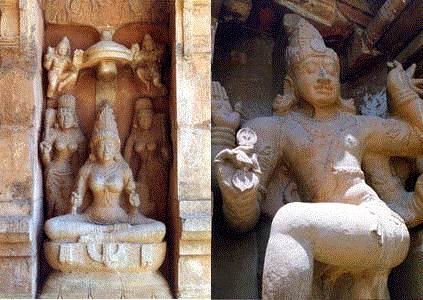
World Heritage Sites - Chola Temple - Brhadisvara

Great Living Chola Temples

[Brihadisvara Temple at Thanjavur; Temple of Gangaikondacholisvaram;
and Airavatesvara Temple at Darasuram] (1987, 2004), Tamil Nadu

Date of Inscription: 1987; Extension: 2004

The celebrated Saiva temple at Thanjavur, appropriately called Brihadisvara and Daksinameru, is the grandest creation of the Chola emperor Rajaraja (AD 985-1012). It was inaugurated by the king himself in his 19th regnal year (AD 1009-10) and named it after himself as Rajesvara Peruvudaiyar. Architecturally, it is the most ambitious structural temple built of granite. It has been regarded as a ‘landmark in the evolution of building art in south India’ and its vimana as a ‘touchstone of Indian architecture as a whole’. The temple is within a spacious inner prakara of 240.9 m long (east-west) and 122 m broad (north-south), with a gopura at the east and three other ordinary torana entrances one at each lateral sides and the third at rear. The prakara is surrounded by a double-storeyed malika with parivaralayas. The temple with its massive proportions and simplicity of design provided inspiration for future designs in constructions not only in south India but also in south-east Asia.

The sikhara, a cupolic dome, is octagonal and rests on a single block of granite, a square of 7.8 m weighing 80 tons. The majestic upapitha and adhishthana are common to all the axially placed entities like the ardha-maha and mukha-mandapas and linked to the main sanctum but approached through a north-south transept across the ardha-mandapa which is marked by lofty sopanas. The moulded plinth is extensively engraved with inscriptions by its royal builder who refers to his many endowments, pious acts and organisational events connected to the temple. The brihad-linga within the sanctum is 8.7 m high. Life-size iconographic representations on the wall niches and inner passages include Durga, Lakshmi, Sarasvati and Bhikshatana, Virabhadra, Kalantaka, Natesa, Ardhanarisvara and Alingana forms of Siva. The mural paintings on the walls of the lower ambulatory inside are finest examples of Chola and later periods which depict the contemporaneous scenes with legendary ones.

Sarfoji, a local Maratha ruler, rebuilt the Ganapati shrine. The celebrated Thanjavur School of paintings of the Nayakas is largely superimposed over the Chola murals. The temple is rich in iconography as well as inscriptions which provide an account of events showing achievements, financial arrangements, donations and bearing an impression of contemporary society.

Two great Chola Temples of the 11th and 12th centuries have been added to the 11th century Brihadisvara temple of Thanjavur, inscribed in 1987. The Great Living Chola Temples were built by kings of the Chola Empire, which stretched over all of South India and the neighbouring islands. The site now includes the three great 11th and 12th century Chola Temples: the Brihadisvara temple of Thanjavur, the Temple of Gangaikondacholapuram and the Airavatesvara temple at Darasuram.

The Temple of Gangaikondacholapuram, built by Rajendra I, was completed in 1035. Its 53-m vimana (sanctum tower) has recessed corners and a graceful upward curving movement, contrasting with the straight and severe tower at Thanjavur. It has six pairs of massive, monolithic dvarapalas statues guarding the entrances and bronzes of remarkable beauty inside. The Airavatesvara temple complex at Darasuram, built by Rajaraja II, features a 24-m vimana and a stone image of Shiva. The temples testify to the Cholas brilliant achievements in architecture, sculpture, painting, and bronze casting.

Ticket Rates: 
Admission is free. 
No fee for still photography/ videography with handheld cameras. 
For all other types of photography and videography, the Superintending Archaeologist, A.S.I ,Chennai Circle, Chennai-9 may be contacted (Ph. 044- 25670396/25670397)

Hours of opening: 0630 hrs to 2030 hrs on all days 
Approach: Tanjavur is about 330 km from Chennai which is well connected by rail and road. 


Brihadisvara temple, Gangaikondacholapuram, Dist. Perambalur

Rajendra I (AD 1012-1044), the illustrious son of the great Chola king Rajaraja I (AD 985-1014) chose this location to build a new a great capital city for the Chola Empire most probably during the first quarter of 11th century in order to commemorate his conquest over northern territories. Nonetheless, he not only built a city, now in ruins and excavated partially but also a great temple for Siva. The Brihadisvara at Tanjavur had influenced this temple in many ways like the vast conception of the lay out and massive proportion of the elevation. 

The lay out – the sanctum with its axial units, the Chandikesvara shrine, the cloister mandapa with the subsidiary shrines and a gopura is similar to Tanjavur. The location of two smaller shrines – The South and North Kailasa (now the Amman shrine) are different. But the architect of this edifice has shown remarkable intelligence to correct some of the shortcomings in the design of the Brihadisvara at Tanjavur like the provision for erecting a wooden scaffolding in the masonry of the sanctum, the pleasing elevation by appropriately changing and placing the hara elements etc.

The inscription recording accurately the donations to the God of the temple is missing here. In fact, there is no inscription of Rajendra himself. The earliest inscription is that of his son, but recording the donations of his father. 

The temple has sculptures of exceptional quality like the dancing Ganesa, Ardhanari, Dakshinamurthi, Harihara, Adavallan (Nataraja) (on south wall niches), Gangadhara, Lingodhbhava, Vishnu, Subrahmanya, Vishnu-anugrahmurthi (west wall), Kalanthakamurthi, Durga, Brahma, Bairava, Kamantaka (north wall). But the most outstanding sculptures are found in the niches by the side of the northern entrance steps to the sanctum. They are the Chandesanugrahamurti and Sarasvati. The bronzes of Bhogasakti and Subrahmanya are masterpieces of Chola metal icons. The Saurapitha (Solar altar), the lotus altar with eight deities is considered auspicious. 

A British officer in 19th century considered this temple as the best source for stones for the construction of a weir across the river Kollidam and therefore ordered its demolition. But the temple was not demolished due to protest by the locals. 
Ticket Rates: 
Admission is free. 
No fee for still photography/ videography with handheld cameras. 
For all other types of photography and videography, the Superintending Archaeologist, A.S.I, Chennai Circle, Chennai-9 may be contacted (Ph. 044- 25670396/25670397)

Hours of opening: 0630 hrs to 2030 hrs on all days. 

Approach: Gangaikondacholapuram is about 250 km from Chennai on the road to Kumbakonam. Kumbakonam is connected with Chennai by rail and road. 


Airavatesvara temple, Darasuram, Dist. Tanjavur

Built by the Chola king Rajaraja II (AD 1143-1173), this temple is a gem of Chola architecture. Though much smaller in size when compared to the Brihadisvara temple at Tanjavur and Gangaikondacholapuram, this temple is different as it is highly ornate in execution. The temple consists of a sanctum without a circumambulatory path and axial mandapas. The front mandapa known in the inscriptions as Rajagambhiran tirumandapam, is unique as it was conceptualised as a chariot with wheels. The pillars of this mandapa are highly ornate. The elevation of all the units is elegant with sculptures dominating the architecture. 

A number of sculptures from this temple like the full set of Bhikshatana with rishi patnis is various moods, are now preserved in the Tanjavur Art Gallery. They are the masterpieces of Chola art. Remaining ones like Nagaraja, Agastya, dancing Martanda Bhairava, Sarabhamurti, Ganesa etc., are equally gracious. The labelled miniature friezes extolling the events that happened to the 63 nayanmars (Saiva saints) are noteworthy and reflect the deep roots of Saivism in this region. In fact, the king made donation for the singing of hymns from Thevaram, the Saivite sacred book in Tamil, in this temple. 

The construction of a separate temple for Devi, slightly later than the main temple, indicates the emergence of Amman shrine as an essential component of the south Indian temple complex.
Ticket Rates: 
Admission is free. 
No fee for still photography/ videography with handheld cameras. 
For all other types of photography and videography, the Superintending Archaeologist, A.S.I Chennai Circle, Chennai-9 may be contacted (Ph. 044- 25670396/25670397)

Hours of opening: 0630 hrs to 2030 hrs on all days. 

Approach: Darasuram is a suburb of Kumbakonam and is about 290 km from Chennai. Kumbakonam is connected with Chennai by rail and road.

Monday, May 26, 2014

Reconstructing Richard III: the man behind the myth

On Monday 4th February the results of tests on a skeleton found beneath a Leicester carpark were announced to a global media audience. Lead archaeologist Richard Buckley stated ‘our academic conclusion, beyond reasonable doubt, is that the individual exhumed at Greyfriars in September 2012 is indeed Richard III, the last Plantagenet king of England.’ Matthew Symonds and Carly Hilts look at what this momentous announcement tells us about Richard, and why the Leicester team are so confident they have got their man.

We now know that it was for want of a helmet, not a horse, that Richard III’s kingdom was lost. Tradition has it that as battle raged across fields near Bosworth on the 22nd August 1485, Richard saw Henry Tudor and his escort detach themselves from the rest of their army. Sensing an opportunity to decide the battle – and secure his throne – Richard charged. Whether it was overconfidence from an impetuous warrior king or a last roll of the dice from a man with nothing left to lose is impossible to say. But whatever provoked this final act of Plantagenet generalship, it proved a gamble too far. Outnumbered and then cut off, England’s last Medieval king went down fighting.

The king is dead
Careful study of Richard’s skeleton by Jo Appleby, an osteologist at the University of Leicester, revealed 10 perimortem wounds – that is, injuries occurring at or around the time of death. Eight were to his head, of which only two had been found when CA last reported on Richard (CA 272). As none of these wounds intersect it is impossible to be certain about the order in which they were sustained. It is unlikely, though, that any occurred while Richard was either wearing his helmet or riding a horse.

There is a strong chance, then, that these injuries provide a window into Richard’s last stand: cut off from his army, fighting on foot, his helmet lost, and his comrades falling around him. Three sword or halberd thrusts found Richard’s unprotected scalp, slicing through the skin to shave slivers of bone off the vault of his skull. A fourth blade successfully punctured the top of his skull. Painful but not fatal, the king appears to have fought on, bleeding profusely.

Taken at face value, Richard’s wounds seem to suggest a horrifying end: surrounded by foes while hacking and stabbing blows from swords and halberds rained down on all sides. Deliverance, when it came, took the form of two blows to the back of Richard’s head. One tore through to the inner surface of his skull a full 10.5cm from its entry point. The other was administered with such force that it cleaved away a chunk of skull and exposed the brain. A portion of the severed bone was left dangling on a flap of skin, carrying it to the Greyfriars grave. Consistent with injuries caused by a powerful halberd strike, if the blade had penetrated 7cm into Richard’s brain death would have been instant. Even if it did not, rapid loss of consciousness would have spared him any more. And there was more to come.

Blades that scored a rib and sliced Richard’s right pelvis should have been turned by his armour during combat. Historical sources, however, indicate the perfect opportunity for such injuries to occur. After death Richard’s corpse was stripped naked and slung over a horse like a saddlebag for its inglorious ride back to Leicester. It suggests that one onlooker took this opportunity to affirm their allegiance to the new royal line in a manner that was as crude as it was unambiguous. Drawing a dagger, they thrust its blade upward into Richard’s right buttock with enough force to penetrate the underlying bone.

Lying in a state
A reconstruction of Grey Friars church, where Richard III was buried. Credit - Jill Atherton/University of
LeicesterThanks to the University of Leicester Archaeological Services excavations we now know that following this public spectacle Richard’s remains were delivered to Leicester Greyfriars for burial. Despite occupying a prestigious location in the order’s church choir – as befitted a crowned Christian monarch – Richard’s interment was a far cry from the pomp of a state funeral.

In contrast to the neat grave shafts encountered elsewhere at Greyfriars and in Medieval Leicester, Richard’s was shallow – lying just 0.68m below modern ground level – and roughly cut with sloping sides, a concave base and an irregular shape. Rather than being laid flat, the body appears to have been bundled into the too-short cut legs first, with the head propped up against a corner of the shaft, its mandible lolling vacantly.

An absence of iron nails and copper pins indicates that the deceased was dignified with neither a coffin nor shroud. The position of Richard’s arms does, though, suggest that one accessory accompanied him to the grave. In a Medieval burial the body’s arms normally run neatly parallel to the side, but Richard’s reached untidily across his body, with his hands cupped over the pelvis. Crossed right over left at the wrists, his arms bear all the hallmarks of being bound when he was buried. If so, it seems that his corpse was committed to posterity as the captive Richard refused to be in life.

A life less ordinary
Richard's remains. The sideways curve of his spine - evidence of severe scoliosis - can be claerly seen. Credit - University of LeicesterSo what can the Greyfriars skeleton tell us about the man whose life ended so ignominiously? It is now well known that Richard III suffered from severe scoliosis – a sideways curvature of the spine. This condition would have significantly shortened his height while standing. Analysis of the skeleton suggests that Richard’s natural height was around 5’8”. This is above average for the period, but unsurprising given that his brother, Edward IV, was also unusually tall. Measuring 6’4”, Edward still holds the record as England’s tallest monarch. Although it is impossible to be certain how many inches the scoliosis cost Richard, the difference could well have been as much as a foot. His right shoulder would have been raised higher than his left.

A life less ordinary
So what can the Greyfriars skeleton tell us about the man whose life ended so ignominiously? It is now well known that Richard III suffered from severe scoliosis – a sideways curvature of the spine. This condition would have significantly shortened his height while standing. Analysis of the skeleton suggests that Richard’s natural height was around 5’8”. This is above average for the period, but unsurprising given that his brother, Edward IV, was also unusually tall. Measuring 6’4”, Edward still holds the record as England’s tallest monarch. Although it is impossible to be certain how many inches the scoliosis cost Richard, the difference could well have been as much as a foot. His right shoulder would have been raised higher than his left.


Another conspicuous feature of the skeleton is the gracile nature of its bones, indicating that Richard had a slender, feminine build. This matches historical accounts of the king, suggesting that the more lurid allegations colouring the Tudor propaganda are exaggerations flowing from a wellspring of truth, rather than the entirely unfounded lies some suspected. Whether the same is true of his character is for historians, not archaeologists, to divine.

Proof of identity
So how can we be sure the remains are those of Richard? While a strong case for the skeleton being the king’s could be made on the strength of its location, its treatment, the curvature of its spine and the clear signs of a battlefield death, further scientific tests were also carried out. Two samples of bone from the ribs were sent to radiocarbon dating labs at the Universities of Oxford and Glasgow. As well as revealing that the individual enjoyed an unusually high protein diet – including large quantities of seafood – for the period, as would befit a prince of the realm, the samples furnished dates that were in close agreement. Once calibrated, and taking into account the tendency for a high seafood diet to return an older radiocarbon date, they indicate a range of AD 1455-1540, entirely consistent with death in 1485.

The project also undertook high profile DNA testing. Turi King, a University of Leicester geneticist, successfully secured a DNA sample from the skeleton’s tooth. This was compared to two direct descendents on the maternal side through Richard’s sister, Anne of York. One was Michel Ibsen, the other was a distant cousin who wished to remain anonymous. Analysis of these three sets of mitochondrial DNA allowed Turi King to conclude that ‘there is a DNA match between the maternal DNA from the family of Richard III and the skeletal remains we found at the Grey Friars dig.’

Wednesday, May 21, 2014

Discovering The Artists of The Eastern Sahara

Recently discovered rock art on the walls of a cave in the Egyptian Western Desert has been provisionally dated by a Cambridge University archaeologist as between 6,000 and 7,000 years old, created at least 1,000 years before the building of the pyramids. The drawings add weight to the argument that Egyptian culture drew on cultural influences from Africa and not only from the Near East.
Spotted by a tourist to Wadi el Obeiyid, north of Farafra Oasis, drawings of a giraffe, a bovid (cow-like mammal) and two boats, plus the outline of a human hand, were examined last month by Dr Giulio Lucarini who co-leads a team of archaeologists looking at the pathways, and timings, by which domestic animals and plants from the Levant arrived in Egypt. The engravings are thought to have been discovered in 2010. The onset of revolution in Egypt meant that they were not investigated for some time.

Based at the McDonald Institute for Archaeological Research at Cambridge University, Lucarini is an expert
in the transition from foraging to farming in North Africa. With Professor Barbara Barich of ISMEO in Rome, he is co-director of a project (the Archaeological Mission in the Farafra Oasis) that has been studying the archaeology of this region of the Eastern Sahara since the late 1980s.
Earliest artistic evidence
The site of the newly-identified images – which are engraved into the white chalk surface – has been dubbed the Boats Arch, a reference to the shape of the shallow cave. The location is 600 km southwest of Cairo and 50 km into the desert from the nearest paved road at Farafra  – a journey across a desert track surrounded by beautiful sand dunes.
Boats Arch is about 3 km from another site – known as Wadi el Obeiyid Cave – where examples of rock art were first examined by Barich in 1995. The art in this first cave features representations of engraved boats and animals as well as painted hand stencils.  “What’s really exciting is that these drawings are among the earliest artistic evidence of the people who lived in the Farafra and possibly in the whole Eastern Sahara,” said Lucarini.
Rock art is notoriously tricky to date. “The marked similarity in style seen in the bovid, which is probably an oryx, and giraffe in the Boats Arch and the animals in Wadi Obeiyid Cave, dated to around 6000/5500 BC, suggests a similar period for the two sites. In style the boat images correlate to those found on decorated pots from Predynastic sites along the Nile Valley, dated around 3500 BC. But we can presume from the regrowth of calcite crystals along their engravings, possible under humid conditions, that they could be even older,” said Lucarini.

Farafra’s rock art sites are 600 km from the Red Sea, 400 km from the Mediterranean and 300 km from the Nile.

“The location is another important for another aspect of the find,” said Lucarini.  “Representations of boats in the Egyptian Western Desert are rare in comparison to those in the Eastern Desert, a region which connects the Nile valley with the Red Sea. They could have been created by people who were moving across very long distances and could have visited the sea or the Nile Valley. In the sites we investigated we did not find any faunal remains belonging to giraffe so, like the images of boats, the drawing of the giraffe may represent not a local element but something seen somewhere else and considered exotic.”

Building a picture of the transition
The Archaeological Mission in the Farafra Oasis is building a picture of the transition from foraging societies to communities based on the exploitation of domestic species. Today the Wadi el Obeiyid landscape is arid and characterised by white limestone formations and high sand dunes, but thousands of years ago the region was a savannah-like environment with grasslands offering subsistence to human groups and animals.

“Since 1987, we have had permission from the Egyptian Ministry of State for Antiquities to survey some 10,000 square kilometres of desert. Our starting point in the research is the use of satellite images which enable us to identify past sources of water and therefore where settlements may have been located. We then carry out detailed walking surveys of these areas to try to locate the presence of old seasonal lacustrine basins, shallow pools, around which people used to live,” said Lucarini.

Over the past years Lucarini and team have been studying the remains of Sheikh el Obeiyid village, a slab structure site with stone circles that were once the foundations of huts made with animal skin and vegetation. “We’ve also found tumuli containing corridor structures. They weren’t dwellings, burials or storage spaces. They may have had a religious or symbolic function,” he said.
“In the past archaeologists have tended to see Africa as somehow lagging ‘behind’ Europe and the Near East, but our work shows that people living in the Eastern Sahara had a significant and developed culture – which fed into the development of the Pharaonic civilization and beyond.”
Lucarini is keen to develop training programmes for Egyptian Antiquities inspectors, teachers and school children in order to share the team’s research into the region’s archaeological and environmental significance and underline the importance of preserving the cultural heritage, which is, at present, vulnerable to damage.

Saturday, May 17, 2014

Exclusive: Found after 500 years, the wreck of Christopher Columbus’s flagship the Santa Maria


The wreck of the ‘Santa Maria’, as envisaged in 1492

Shipwreck found off coast of Haiti thought to be one of the most significant underwater discoveries in history
More than five centuries after Christopher Columbus’s flagship, the Santa Maria, was wrecked in the Caribbean, archaeological investigators think they may have discovered the vessel’s long-lost remains – lying at the bottom of the sea off the north coast of Haiti. It’s likely to be one of the world’s most important underwater archaeological discoveries.

“All the geographical, underwater topography and archaeological evidence strongly suggests that this wreck is Columbus’ famous flagship, the Santa Maria,” said the leader of a recent reconnaissance expedition to the site, one of America’s top underwater archaeological investigators, Barry Clifford. 

“The Haitian government has been extremely helpful – and we now need to continue working  with them to carry out a detailed archaeological excavation of the wreck,” he said.

So far, Mr Clifford’s team has carried out purely non-invasive survey work at the site – measuring and photographing it.

Tentatively identifying the wreck as the Santa Maria has been made possible by quite separate discoveries made by other archaeologists in 2003 suggesting the probable location of Columbus’ fort relatively nearby. Armed with this new information about the location of the fort, Clifford was able to use data in  Christopher Columbus’ diary to work out where the wreck should be.

An expedition, mounted by his team a decade ago, had already found and photographed the wreck – but had not, at that stage, realized its probable identity.

It’s a current re-examination of underwater photographs from that initial survey (carried out back in 2003), combined with data from recent reconnaissance dives on the site (carried out by Clifford’s team earlier this month), that have allowed Clifford to tentatively identify the wreck as that of the Santa Maria.

The evidence so far is substantial. It is the right location in terms of how Christopher Columbus, writing in his diary, described the wreck in relation to his fort.

The site is also an exact match in terms of historical knowledge about the underwater topography associated with the loss of the Santa Maria. The local currents are  also consistent with what is known historically about the way the vessel drifted immediately prior to its demise.

The footprint of the wreck, represented by the pile of ship’s ballast, is also exactly what one would expect from a vessel the size of the Santa Maria.

Using marine magnetometers, side-scan sonar equipment and divers, Mr. Clifford’s team has, over several years, investigated more than 400 seabed anomalies off the north coast of Haiti and has narrowed the search for the Santa Maria down to the tiny area where the wreck, which the team thinks may well be Columbus’ lost vessel, has been found.

World Heritage Sites - Fatehpur Sikri

Fatehpur Sikri (1986), Uttar Pradesh
Sikri an extension of the upper Vindhyan ranges is situated on the bank of a large natural lake, which has now mostly dried up. It is a pre-historic site and, with abundant water, forest and raw material, it was ideal for primitive man’s habitation. Rock shelters with paintings exist on the periphery of the lake. Stone age tools have been found in this area. Ochre Coloured Pottery (c. 2nd millennium B.C.) and Painted Grey Ware (c.1200-800 B.C.) have also been discovered from here.


Sikri has been mentioned in the Mahabharata as ‘Saik’. Lexicons define ‘Saik’ as a region surrounded by water. An inscription found on the stone sculpture of Jaina Saraswati (dated 1067 Vikram Samvat = 1010 A.D.) mentions this place as ‘Sekrikya’, which seems to be a similar derivative. All this shows that Sikri was continuously inhabited since the prehistoric period.


Babur visited the place on the eve of the Khanwah battle in A.D. 1527 and mentioned it as ‘Sikri’ in his Memoirs. He founded here a garden and a Jal-Mahal surrounded by the lake-water, and a baoli (step-well) to commemorate his victory in the Khanwah battle.

Akbar (1556-1605), grandson of Babur, shifted his residence and court from Agra to Sikri, for a period of 13 years, from 1572 to 1585 to honour the Sufi Saint Sheikh Salim Chishti, who resided here (in a cavern on the ridge). Akbar revered him very much as the Saint had blessed him with a son who was named Salim in 1569. He raised lofty buildings for his use, and houses for the public. Thus grew, a great city with charming palaces and institutions. Akbar gave it the name of Fathabad and which in later days came to be known as “Fathpur Sikri”.


Here practically, all Mughal institutions such as the ‘Ibadat-Khanah’, ‘Din-i-Ilahi’, ‘Tarikh-i-Ilahi’ , Jharokha-Darshan, the doctrine of Sulh-i-Kul and policy of liberal patronage to indigenous arts and literatures, were founded. It was also here that workshops of various handicrafts were established.

Sikri was the first planned city of the Mughals. The sloping levels of the city were connected into terraces which were utilised for various complexes such as Jami masjid, Buland-Darwazah and tomb of Sheikh Salim Chishti; Khass Mahal, Shahi-Bazar, Mina-Bazar, the Panch-Mahal, Khwabgah, Diwan-i-Khass, Anup-Talao, Chaupar and Diwan-i-Am. The efficient system of drainage and water-supply adopted here suggest an extremely intelligent town-planning by the Mughal emperor.

All these palaces were built of red sandstone in the trabeate beam-and-post order, and composed of pillars, ornamental arches, brackets-and-chhajjas, jharokhas, chhatris, chhaparkhats, chaukhandis and so on. Domes have been used sparingly. Sometimes corbelled pendentives have been employed in the transition phase.

The architecture of Fatehpur Sikri has a definite all-India character. It is prolific and versatile Indo-Muslim composite style, which is a fussion of the composite cultures of indigenous and foreign origins


Open from sunrise to sunset

Entrance Fee:

Citizens of India and visitors of SAARC (Bangladesh, Nepal, Bhutan, Sri Lanka, Pakistan, Maldives and Afghanistan) and BIMSTEC Countries (Bangladesh, Nepal, Bhutan, Sri Lanka, Thailand and Myanmar) - Rs. 10 per head.

Others:
US $ 5 or Indian Rs. 250/- per head (ASI);
Rs. 10/- per head (ADA)

Rs. 500/- ticket of ADA purchased at Taj Mahal is valid for the monuments of Agra Fort, Itimadi-ud-daula, Akbar’s Tomb, Sikandara and Fatehpur Sikri

(children up to 15 years free)

Copyright © 2014 Archaeology Excavation